Sending money abroad with USDT vs a bank transfer: which costs less? A$1,500 from Sydney to Bangkok, sent three ways and costed in full
USDT came out cheaper in our example: sending A$1,500 (about US$1,000) from Sydney to Bangkok cost about A$11, or 0.7%, against roughly A$55, or 3.7%, by bank wire (a flat A$10 fee plus a typical 3% markup in the rate). USDT is a crypto token built to stay worth US$1; here it cost a 0.1% fee to buy, 0.01 USDT to send on BNB Smart Chain, then the recipient’s selling fee and baht withdrawal. A good transfer service lands close, at about 1%, with far fewer steps.
On this page
- A$1,500 to Bangkok: how much arrives by bank, transfer service and USDT
- USDT transfer fees: which network is cheapest to send on?
- How to send money with USDT, step by step
- Wrong network, frozen account or scam: what can go wrong
- When a bank or a transfer service is the better choice
- Questions about sending money with USDT
A$1,500 to Bangkok: how much arrives by bank, transfer service and USDT
All three routes start with the same money. At the reference rate (the mid-market rate, halfway between buying and selling prices) of 22.60 baht per Australian dollar, A$1,500 is worth 33,901 baht. Each route then loses a slice on the way.
| Route and what you pay | Baht received | Cost |
|---|---|---|
| Bank wire A$10 fee + 3% markup in the rate | 32,665 | 3.7% (A$55) |
| Transfer service About 1% all-in (fee + small markup) | 33,562 | 1.0% (A$15) |
| USDT on BNB Smart Chain 0.1% fee + 0.3% spread to buy, 0.01 USDT to send, 0.25% to sell, 20 baht to withdraw | 33,661 | 0.7% (A$11) |
| USDT on Tron (TRC20) Same, but 2 USDT to send | 33,594 | 0.9% (A$14) |
What the table assumes, so you can swap in your own numbers:
- Reference rates: AUD/THB 22.60, AUD/USD 0.6666 and USD/THB 33.91, worked out from the European Central Bank’s euro reference rates for 20 November 2026.
- Bank wire: a flat A$10 fee and a rate 3% worse than the reference rate. Both are assumptions; banks commonly sit somewhere between 2% and 4%. A correspondent bank (a middle bank that passes the payment on) can take a further fee, which is not in the table.
- Transfer service: about 1% in total. This is an assumption; get a live quote for your own amount.
- Stablecoin route: the 0.1% spot trading fee is from the Binance fee schedule (regular account, checked November 2026) and the network fees are from its withdrawal fee list (checked 23 November 2026). The 0.3% buying spread, the recipient’s 0.25% selling fee and the 20-baht bank withdrawal are assumptions.
The usual yardstick is the World Bank’s Remittance Prices Worldwide survey. In its latest published figures, for the third quarter of 2025, sending US$200 cost 6.36% on average worldwide, 4.59% through digital services and about 15% through banks. Percentages on a US$200 transfer run higher than on US$1,000, because flat fees weigh more on small amounts, but the ranking holds: banks cost the most. The United Nations goal is under 3% by 2030.
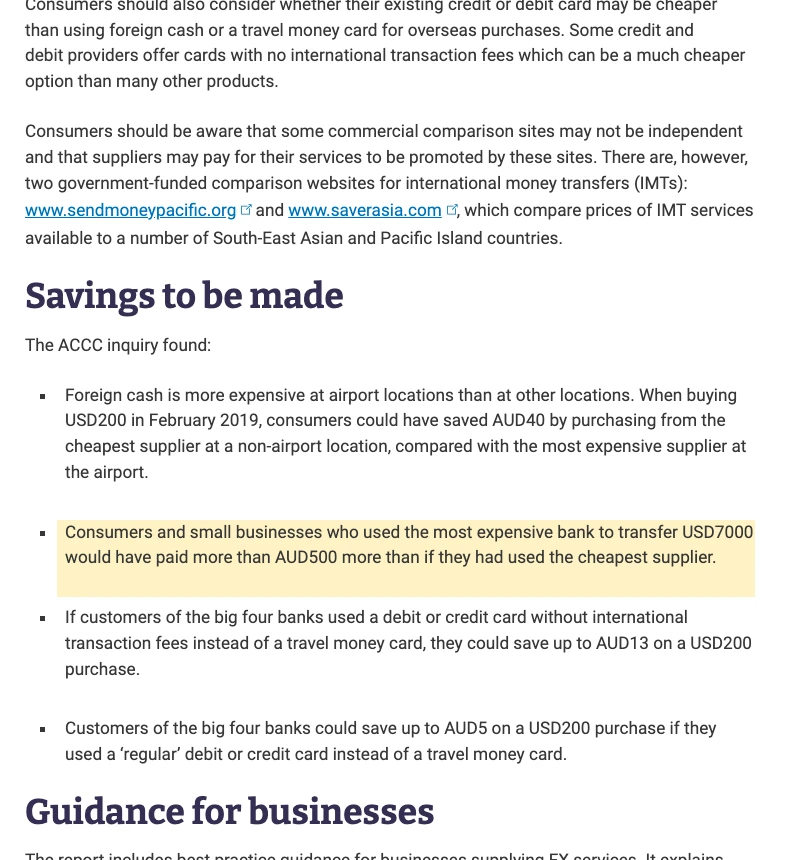
Australian banks have been measured too. When Australia’s competition regulator, the ACCC, studied foreign currency services in 2019, it found that someone sending US$7,000 through the most expensive bank paid more than A$500 more than with the cheapest provider.
Two things move the result more than anything else. One is the markup your bank actually uses: work it out from a real quote with the exchange-rate margin calculator, or see what a 1%, 3% or 5% markup costs in dollars. The other is the price the recipient gets when selling. On 23 November 2026, USDT sold for about 34.13 baht on a large licensed Thai exchange, about 0.6% above the reference rate, which would have made the stablecoin route cheaper still. That premium changes daily and can turn into a discount, so the table leaves it out.
USDT transfer fees: which network is cheapest to send on?
USDT (Tether’s dollar token) and USDC (Circle’s) each exist on several blockchains, called networks. When you withdraw from an exchange, the exchange charges a flat fee that depends on the network, not on the amount. These were the fees on the Binance withdrawal fee list on 23 November 2026:
| Network | USDT fee | USDC fee |
|---|---|---|
| BNB Smart Chain (BEP20) | 0.01 | 0 |
| Polygon PoS | 0.03 | 0.12 |
| Solana | 0.7 | 0.3 |
| Ethereum (ERC20) | 0.6 | 1 |
| Tron (TRC20) | 2 | – |
Fees are charged in the token itself, so 2 USDT is about US$2. Binance doesn’t offer USDC on Tron. The fees change with network traffic, and the minimum withdrawal is 2.6 to 5 USDT depending on the network. Tron is the most widely accepted network for USDT but also the dearest of the common ones; on A$1,500 the difference is about A$3. The cheapest network is only useful if the recipient’s exchange accepts deposits on it, which is why step 2 below comes before you send anything.
USDT or USDC makes little difference to the cost. Pick whichever the recipient’s exchange lists with a baht (or Taiwan dollar, or other local currency) market, because that is the one they can sell.
How to send money with USDT, step by step
The route has three parts: you buy a stablecoin, send it on a network both sides support, and the recipient sells it for local currency and withdraws to their bank. In detail:
- Open an exchange account and buy USDT or USDC. You’ll go through identity checks first. Then fund the account with Australian dollars using whichever method your account offers and buy on the spot market (the ordinary buy and sell screen, at the current price), where the fee is 0.1%. A card purchase or a one-tap “buy crypto” button usually costs more; the price is shown before you confirm, so compare it with the spot price.
Up to 20% back on trading fees*Open the Binance sign-up pageReferral codeZY1818
*The rebate that applies is the one shown on the sign-up page. This is a referral link: we may earn a commission, and it doesn't make your fees higher. Crypto prices can swing sharply; nothing here is investment advice.
The sign-up screens, the identity check and the fee tiers are covered in our guide to opening a Binance account.
- Ask the recipient for a deposit address and the network name. They open the deposit screen for USDT (or USDC) on their own exchange, choose a network, and send you both the address and the network name exactly as shown. Ask them to pick the cheapest network their exchange accepts.
- Send a small test amount. On your exchange’s withdrawal screen, paste the address, choose the same network, and send just above the minimum, for example 10 USDT. Wait until the recipient sees it credited.
- Send the rest. Use the same address and network. On BNB Smart Chain or Tron it usually arrives within minutes, though either exchange can hold a large withdrawal or deposit for a check.
- The recipient sells for baht and withdraws. They sell USDT on their exchange’s USDT/THB market, then withdraw the baht to a bank account in their own name. In some countries a sale counts for tax, so they should keep the records.
The same route works to Taipei, with the recipient selling for Taiwan dollars instead of baht. Only the last step changes.
Wrong network, frozen account or scam: what can go wrong
USDT on Tron and USDT on BNB Smart Chain are the same token on different networks, and you can’t send from one to the other. If you withdraw on a network the recipient’s exchange doesn’t support, the deposit never arrives. Some exchanges recover such deposits for a fee, many can’t, and no one can reverse a blockchain transfer. Copy the network name from the recipient’s screen and always send a test first.
- The recipient can’t sell where they live. The recipient needs an account at an exchange in their own country that can sell USDT or USDC for local currency and pay out to a local bank. In Thailand that means an exchange licensed by the Securities and Exchange Commission, and since 2022 Thai rules have barred licensed firms from helping people pay for goods and services with crypto, so the recipient sells for baht rather than spending USDT. In Taiwan, the Financial Supervisory Commission lists the platforms that have completed its anti-money-laundering registration. If there is no licensed exchange the recipient can use, this route isn’t for them; use a bank or a transfer service.
- Frozen accounts and frozen tokens. An exchange can freeze an account while it checks where money came from. This happens most often after peer-to-peer (P2P) trades, buying from or selling to another person directly, where a stranger’s payment later turns out to be stolen. Tether and Circle, the companies behind USDT and USDC, can also freeze specific addresses at the request of law enforcement.
- Scams. No real exchange or support agent will ask for your password, a 2FA code (the one-time login code) or a recovery phrase, or ask you to pay a fee to “release” a transfer. Anyone offering to sell USDT outside an exchange at a better-than-market price is a common fraud.
- Price. USDT and USDC are built to stay at US$1 and usually trade within a fraction of a cent of it, but they are not bank deposits and are not covered by deposit insurance. Bitcoin and other coins that are not tied to the dollar can move several percent in a few hours, so they are a poor way to send a fixed sum.
Before you sign up anywhere, take five minutes to check that the exchange is licensed in the country where it serves you.
When a bank or a transfer service is the better choice
The stablecoin route saves the most against a bank wire. Against a good transfer service it saves little, often a few dollars on A$1,500, and it asks both people to open exchange accounts, pass identity checks and handle a transfer that can’t be reversed. A bank or a transfer service is usually the better choice when:
- the recipient has never used an exchange, or has no licensed one where they live;
- the transfer is a one-off and setting up two accounts would take longer than the money saved is worth;
- the money must go to a business, a landlord or a school that needs a bank transfer with a reference;
- a transfer service already quotes close to the reference rate for your currency pair, which is common on busy routes such as AUD to THB.
Whichever way you send, judge it by the baht that actually arrive, not by the advertised fee. The guide to the real cost of sending money abroad explains how to compare banks and transfer services on that one number.
Questions about sending money with USDT
Is it cheaper to send money abroad with USDT than with a bank?
Usually yes, if the recipient can sell USDT for local currency on a licensed exchange in their own country. In our A$1,500 Sydney-to-Bangkok example the USDT route cost about 0.7% against about 3.7% for a bank wire. A good transfer service came in at about 1%, so the gap against a service is small.
Which network is cheapest for sending USDT?
On the Binance withdrawal fee list checked on 23 November 2026, BNB Smart Chain (0.01 USDT) and Polygon (0.03 USDT) were the cheapest, and Tron (TRC20) was the most expensive common choice at 2 USDT. The cheapest network only helps if the recipient’s exchange accepts deposits on it.
Can you transfer USDT to a bank account?
Not directly. The recipient first sells the USDT for local currency on an exchange, then withdraws that money to their bank account. That needs an exchange account in their own country that pays out to local banks.
Is it legal to send money abroad with crypto?
It depends on the rules in both countries, and the recipient’s country usually matters most. In many places holding and selling stablecoins on a licensed local exchange is allowed, while paying for things with them or using unlicensed platforms is not. If the recipient has no licensed exchange to sell on, use a bank or a transfer service instead.
What happens if I send USDT on the wrong network?
In most cases the money is lost or stuck. If the receiving exchange does not support that network, the deposit never appears; some exchanges can recover it for a fee, many cannot. Always copy the network name from the recipient’s deposit screen and send a small test first.
Read next
- World Bank — Remittance Prices Worldwide, global average cost of sending US$200 (Q3 2025 report): remittanceprices.worldbank.org
- ACCC — “Australians paying millions too much for foreign currency services”, 2 September 2019: accc.gov.au
- European Central Bank — euro foreign exchange reference rates, 20 November 2026: ecb.europa.eu
- Binance fee schedule (spot trading, regular account) and Binance withdrawal fee list for USDT and USDC, both checked November 2026
- Securities and Exchange Commission, Thailand — licensed digital asset business operators: sec.or.th
- Financial Supervisory Commission, Taiwan — virtual asset service providers that have completed AML registration: fsc.gov.tw
- International Monetary Fund — how stablecoins can affect payments and remittances: imf.org
Last updated 23 November 2026. Exchange fees, network fees and rates in this guide were checked on 23 November 2026 and change often; figures marked as assumptions are examples, not quotes. This guide is general information, not financial, tax or legal advice.