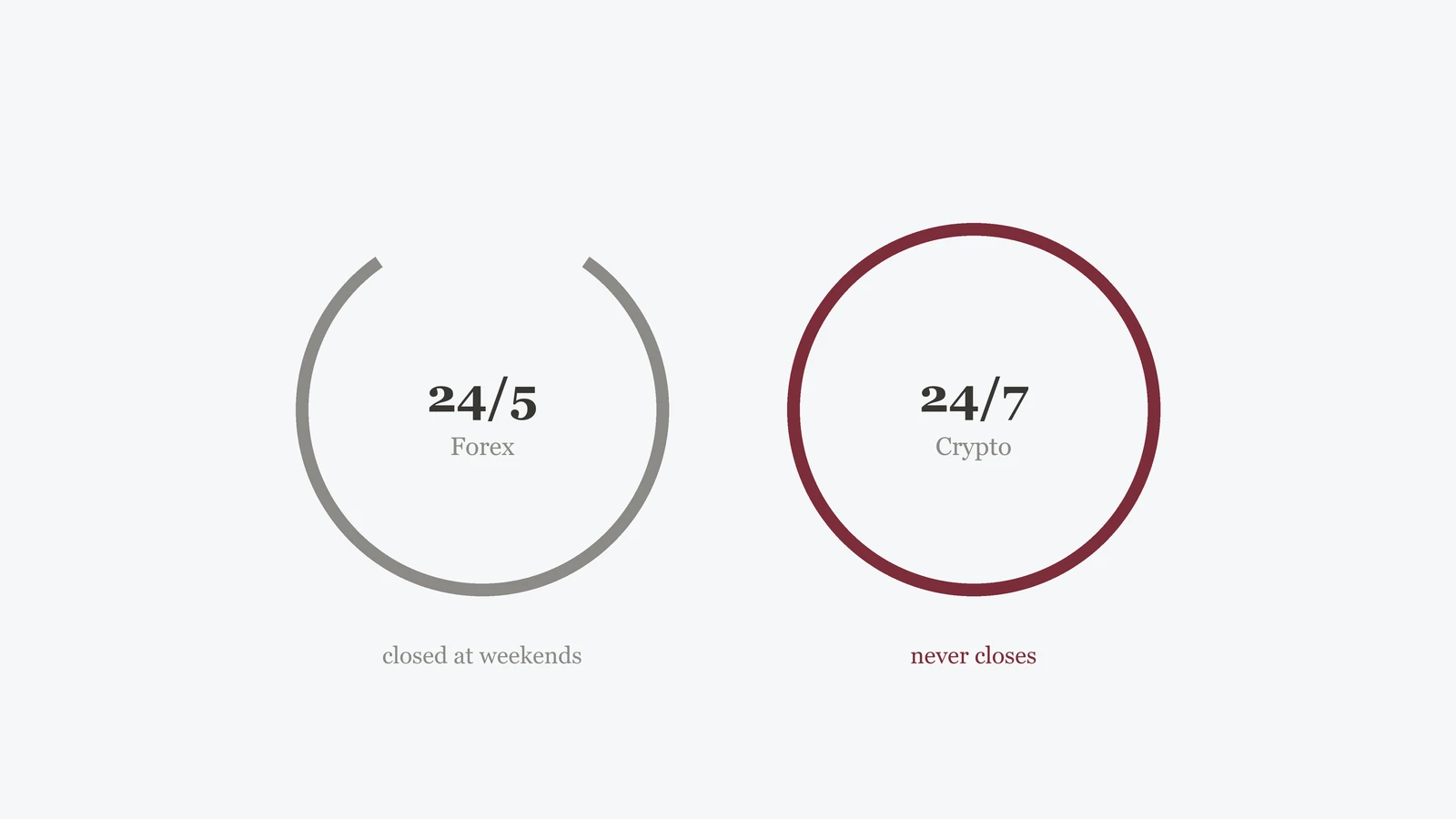
FX closes for the weekend. Crypto never does — for better and worse How the currency market and the 24/7 crypto market differ on hours, access, custody and risk
One of these markets closes on Friday evening and reopens on Sunday. The other has never closed at all. A surprising amount of what separates foreign exchange from crypto follows from that single difference, and from a second one: who is holding the asset while you are asleep. What follows sets them side by side on hours, access, custody and risk, with the risk section written plainly rather than diplomatically.
On this page
The honest summary
The foreign-exchange market is enormous, deeply liquid and heavily regulated. It runs in overlapping regional sessions, closes over the weekend, and most ordinary people reach it through a broker. The crypto market is different in a few structural ways: it trades around the clock, every day of the year; the barrier to start is usually lower; and you can hold the asset yourself (“self-custody”) or leave it with an exchange. Each of those differences carries a cost alongside its appeal. No weekend gap and a small starting amount sound convenient — but the same market is typically far more volatile, puts custody (and its risks) on your shoulders, and attracts more scams aimed at newcomers. This guide compares the two honestly so you can judge the trade-offs for yourself.
A quick recap of the FX market
You already know most of this, so we’ll keep it short. The currency market is where one currency is exchanged for another, quoted as a pair such as EUR/USD. It is the largest and most liquid market in the world — the Bank for International Settlements measures daily turnover in the trillions — which is part of why spreads on major pairs are usually tight. It is also session-bound: liquidity follows the working day around the globe through the Sydney, Tokyo, London and New York sessions, and it pauses over the weekend. Access for an individual is almost always through a regulated broker, and in most countries that broker operates under a recognised financial authority. In short: large, liquid, regulated, session-bound, broker-accessed. Hold that picture as the reference point for everything that follows.
What the crypto market is
The crypto market is where digital assets such as Bitcoin or Ether are bought, sold and converted. Three features set it apart from FX from the start. First, it never closes — it trades 24 hours a day, 365 days a year, across a global patchwork of platforms, so there is no opening bell and no weekend pause. Second, the barrier to begin is usually lower: you can often start with a small amount rather than the account minimums some brokers expect. Third, you choose how to hold it. You can self-custody — keep the asset in a wallet whose keys only you control — or you can hold it on an exchange, much as you’d leave cash with a broker. Each choice carries its own responsibilities and its own risks, which we’ll come to.
One more honest caveat up front: “crypto” covers thousands of very different assets, and regulation of them varies enormously from one country to the next. What is legal, available and supervised where you live may be restricted or unavailable elsewhere. Treat anything general you read — including this page — as a starting point, not as advice for your situation.
Side by side, at a glance
Here is the comparison in one table. Everything below is general and illustrative — it describes how the two markets tend to behave, not a quote or a promise about any specific platform or asset.
| Feature (illustrative, general) | Foreign exchange | Crypto market |
|---|---|---|
| Trading hours | Sessions around the clock on weekdays; closed over the weekend | Open 24 hours a day, every day of the year |
| Who can access | Usually via a regulated broker; account checks and minimums are common | Lower barrier to start; often a smaller starting amount, where the platform is available to you |
| How you hold it | Positions sit in your broker account; you don’t custody the currency yourself | You can self-custody in your own wallet, or hold via an exchange — the choice, and its risks, are yours |
| Typical volatility | Major pairs usually move modestly day to day | Often far more volatile; large swings, up or down, are common |
| What backs the price | National economies, interest rates, trade and policy | Supply and demand for the asset; no central bank or government backing |
| Regulation | Mature, broadly consistent oversight in most major markets | Developing and uneven; rules vary a lot by country |
| Weekend gap | Market is shut; prices can “gap” when it reopens | No weekend gap — it keeps trading, including overnight and on holidays |
The single biggest structural difference is the highlighted row: in FX you don’t personally custody the currency, whereas in crypto you might. That one choice is where a lot of the convenience — and a lot of the risk — lives.
What “24/7 and a low barrier” really changes
For a normal person, two crypto features stand out, and it’s worth being honest about both sides of each.
No weekend gap. Because the market never closes, you’re never stuck waiting for Monday to act, and there’s no opening “gap” where the price leaps past where you expected. The flip side: a market that never sleeps is a market that can move sharply at 3am on a Sunday, when you’re not watching and support lines may be quiet.
You can start small. A lower barrier means you can learn with an amount you’re comfortable losing, rather than committing a large minimum. That’s genuinely useful for learning. The flip side is twofold: the same accessibility means it’s easy to add more impulsively, and — because you may be holding the asset yourself — you become responsible for custody. Lose your recovery phrase or send to the wrong address and there is usually no help desk that can reverse it.
And underneath both is volatility. The friction-free, round-the-clock nature of the market is paired with price swings that are typically much larger than major currency pairs. Convenience does not reduce risk; if anything, it makes it easier to act on impulse during a swing.
The risks of crypto, stated plainly
This is the part to read slowly. The crypto market carries risks that differ in kind and degree from regulated FX, and they deserve to be stated without softening:
- Price volatility. Values can move a long way in a short time, in either direction. People can and do lose money — sometimes a large share of what they put in.
- Transfers are typically irreversible. Once a crypto transfer is confirmed, there is usually no way to claw it back. A mistyped address or a transfer made under pressure is often gone for good.
- Platform and custody risk. If you hold on an exchange, you depend on that platform’s security and solvency. If you self-custody, the security falls entirely to you — lose the keys and you lose access.
- Scams target newcomers. Fake “support” staff, fraudulent platforms, impersonation and “send us crypto to unlock more” schemes are common, and beginners are the favourite target.
- Rules vary a lot by country. In the UK, for example, Binance has taken no new users since 2023, crypto derivatives can’t be sold to retail customers at all, and selling or swapping crypto can be a taxable disposal. The next section shows how to check your own position.
None of this means crypto is universally “bad” or FX is universally “safe.” FX carries real risk too, especially with leverage. The point is that the crypto market shifts more responsibility — for custody, for verifying platforms, for weathering volatility — onto you. Go in only with money you can afford to lose, and only after you understand what you’re holding.
Walk away immediately if anyone promises returns or “guaranteed” outcomes, asks for your seed phrase or recovery phrase (no legitimate service ever needs it), or demands a “release,” “unlock” or “activation” fee to free up money that’s supposedly yours. These are not quirks of a volatile market; they are the signatures of a scam.
Who each market tends to suit
Neither market is “better.” They suit different needs, and the honest framing is about fit, not endorsement.
The FX market tends to suit people who want a mature, regulated environment with deep liquidity, tight spreads on majors, and the comfort of broad oversight — and who don’t mind that it pauses on weekends. Much of the activity here is also practical rather than speculative: converting money for travel, paying overseas, or running a business that deals in more than one currency.
The crypto market tends to draw people who want round-the-clock access, a low barrier to start, and the option to self-custody — and who are willing to accept higher volatility, greater personal responsibility, and a regulatory picture that is still settling. It is not a place to put money you can’t afford to lose, and it is not a shortcut to returns.
Plenty of people never touch crypto at all and are perfectly well served by understanding currencies. Curiosity is a fine reason to learn how the crypto market works; it is not, by itself, a reason to buy.
How to look before you leap
If, after weighing all of the above, you want to explore the crypto market, do it carefully and slowly. The goal here is to reduce avoidable mistakes, not to encourage the leap.
- Confirm it’s available and regulated where you live. In the UK, search the platform’s legal name on the FCA’s Financial Services Register; in the EU, check ESMA’s list of authorised crypto-asset service providers; elsewhere, the national financial regulator’s website. For Binance in particular, the places where it takes no new accounts are listed in opening a Binance account.
- Choose a reputable platform and check it independently. Ignore anything that arrives unsolicited in a message, a DM or an advert, and read the platform’s own terms and fee pages before you commit money rather than taking a summary’s word for it.
- Start small. Use an amount you could lose entirely without it mattering. Treat the first transactions as tuition, not as an investment.
- Verify everything on the platform’s own page. Fees, supported assets, withdrawal rules and availability are set by the platform and change — read the live figures there, not on a third-party summary.
- Never share secrets. No legitimate platform or “support agent” will ever ask for your password, 2FA codes, or recovery phrase. Anyone who does is trying to rob you.
- Run a final pre-signup check. Before you commit, work through the conversion & pre-signup checklist the same way you would before any account.
The same discipline you’d use to read a currency quote against the mid-rate works here: verify the source, read the all-in figures yourself, and don’t act under time pressure. Markets that are “always open” reward patience, not haste.
If you decide to go ahead, the next question is a practical one: what the account itself costs to run. Opening an account without overpaying walks through the sign-up in order, where an invite code goes, and which of the four separate costs a fee discount actually reduces — along with the three it never touches.
Questions people ask
Is crypto just “forex but newer”?
No. They share some mechanics — pairs, spreads, a buy and a sell price — but they differ in custody, volatility, regulation and hours. Treating crypto as “FX with extra hours” underestimates the additional risk and the custody responsibility it puts on you.
Does trading 24/7 make crypto safer because I can always exit?
Not really. Always-open means you can act any time, but it also means prices can move sharply when you’re asleep or away. Constant availability is a convenience, not a safety net, and it can encourage impulsive decisions during a swing.
What does “self-custody” actually mean for me?
It means you hold the keys to your own assets, with no intermediary. That removes reliance on a platform but makes you solely responsible: lose the keys or recovery phrase and the assets are typically unrecoverable. Holding on an exchange shifts that responsibility to the platform — along with the risk that the platform itself fails.
Should I buy crypto?
Only you can decide, but three answers settle it for most people. Could you lose the whole amount and still pay every bill? Can you say where the crypto will be held and who is able to move it? Is the platform you would use allowed to serve you where you live? A no to any of the three means not yet. Anyone promising you should buy is a warning sign.
- Bank for International Settlements — FX market structure and turnover: bis.org
- International Monetary Fund — research on crypto assets and exchange rates: imf.org
- European Securities and Markets Authority — investor warnings on crypto assets: esma.europa.eu
- U.S. Securities and Exchange Commission investor education — crypto-asset risks and scams: investor.gov
Last updated 29 September 2026. Crypto assets are volatile and higher-risk; you can lose money. This guide is a neutral comparison for education, not investment, tax or legal advice, and not a recommendation to buy. Where Binance does and doesn’t take new users was checked on 29 September 2026.