A price tag with two countries on it: how a currency pair works Base, quote, and what “EUR/USD = 1.08” is actually telling you
Two currencies, one number, and nothing on the screen telling you which is which. That is why a beginner can look at EUR/USD, USD/JPY and GBP/USD in the same layout and take three different meanings from them. Ten minutes here and the ambiguity goes: you will know what the number is counting, which direction counts as up, and what a pip is actually measuring.
On this page
- Two currencies, one price: base and quote
- How to read the number
- Which direction is “up” — and what it means
- Direct vs indirect quotes
- What a pip is, in plain terms
- Reading real examples
- Two easy ways to misread a pair
- How a quote ticks on a live screen
- Cross rates: pairs without the dollar
- Questions people ask
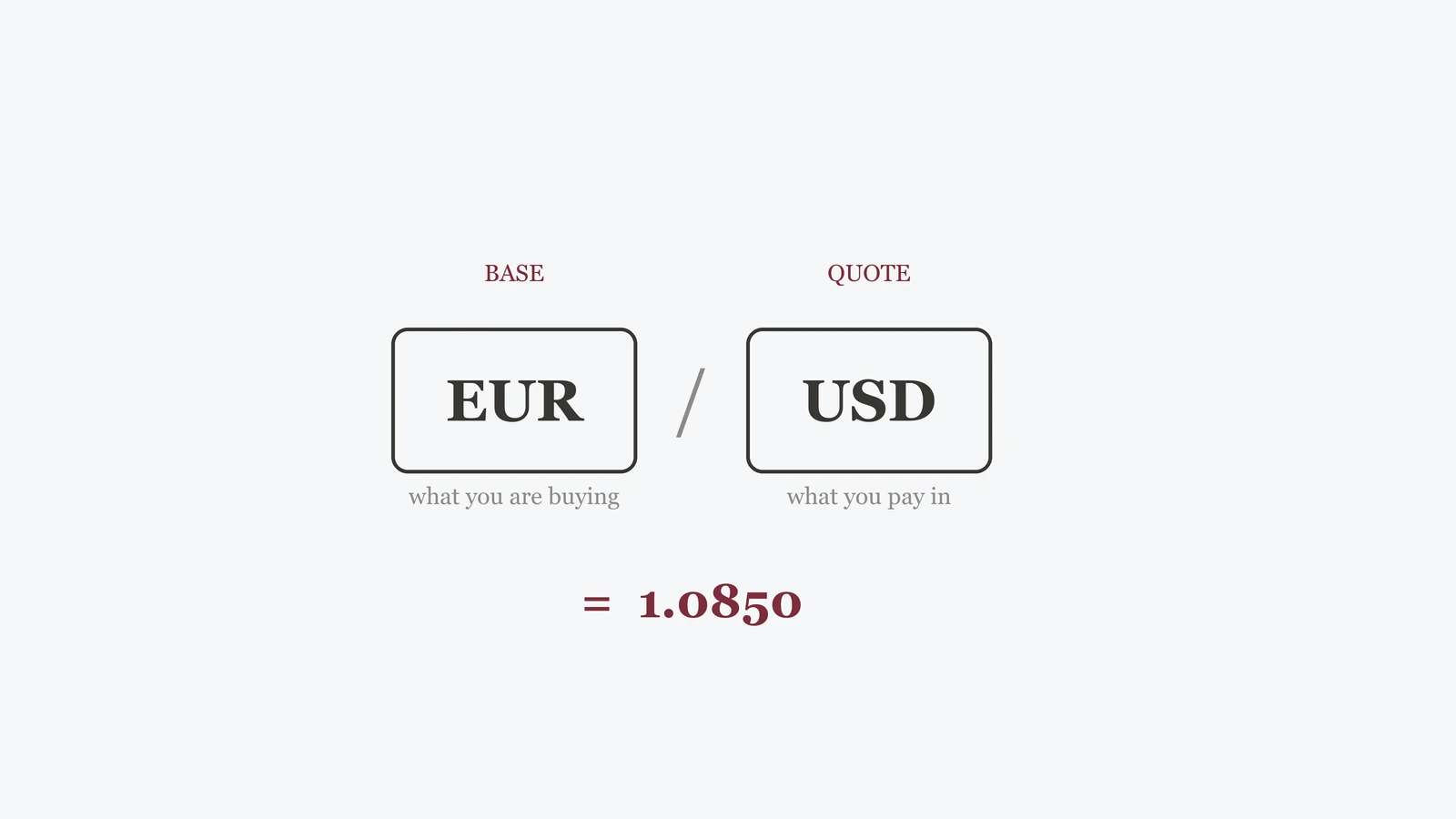
A currency pair is a price tag with two countries on it. The first currency is the base; the second is the quote. The number tells you how many units of the quote currency it takes to buy one unit of the base. So “EUR/USD = 1.08” means one euro costs 1.08 US dollars. Learn to read base, quote and direction, and every pair on every screen suddenly makes sense.
Two currencies, one price: base and quote
A single currency has no exchange rate on its own. “The dollar is 1.08” means nothing — 1.08 of what? A rate only exists between two currencies, which is why prices always come in pairs, written with a slash: EUR/USD, USD/JPY, GBP/USD.
The first currency in the pair is the base currency. The second is the quote currency (sometimes called the counter currency). The convention is simple: the price tells you the cost of one unit of the base, expressed in the quote. Think of it the way a wholesale price list is always written “per case” or “per kilo” — the base currency is the unit, and the quote currency is the money you measure that unit in. In EUR/USD, the euro is the thing being priced and the dollar is the measuring stick.
This is also why the order matters. EUR/USD and USD/EUR are not the same quote written two ways round; they answer two different questions, and they produce two different numbers.
How to read the number
Once you know which currency is the base, the rest follows from one sentence: one unit of the base equals X units of the quote. Read every pair as that sentence and you can’t go far wrong.
- Find the base. It’s the currency on the left of the slash. In USD/JPY, that’s the US dollar.
- Find the quote. It’s the currency on the right. In USD/JPY, that’s the Japanese yen.
- Read the number as a price. “One unit of the base costs this many of the quote.” If USD/JPY is 156, one dollar costs 156 yen.
- Say it as a full sentence. “One US dollar buys 156 Japanese yen.” If the sentence makes sense, you’ve read the pair correctly.
That’s the entire skill. The number is never abstract: it is always “how many of the second currency for one of the first.” (All figures here are illustrative, not a quote.)
Which direction is “up” — and what it means
When a pair’s number goes up, the base currency is getting more expensive in terms of the quote — it takes more of the quote currency to buy one unit of the base. So the base is strengthening and the quote is weakening, relative to each other.
If EUR/USD moves from 1.08 to 1.10, it now takes more dollars to buy one euro: the euro has strengthened against the dollar (equivalently, the dollar has weakened against the euro). If it falls from 1.08 to 1.06, the euro has weakened and the dollar has strengthened. The crucial habit is to read the move relative to both currencies at once. A pair never tells you a currency is “strong” in some absolute sense — only strong or weak against the specific partner it’s paired with. EUR/USD rising tells you nothing about the euro against the yen.
Direct vs indirect quotes: where your home currency sits
The same rate can be written from two points of view, and which one you’re looking at depends on where your home currency sits in the pair.
A direct quote puts your home currency as the quote (second) currency, so the price is expressed in your own money. For someone in the United States, EUR/USD = 1.08 is a direct quote: a foreign unit (the euro) priced in home dollars. It answers “how much of my money for one of theirs?”
An indirect quote puts your home currency as the base (first) currency, so the price tells you how much foreign money one unit of yours buys. For that same US reader, USD/JPY = 156 is an indirect quote: one home dollar buys 156 foreign yen. It answers “how much of their money for one of mine?”
Neither is more correct — they’re the same information seen from opposite ends. Knowing which you’re looking at just stops you from reading the price upside down. If a number feels strangely large or small (one dollar for 156 of something?), check whether your home currency is the base or the quote before you panic.
What a pip is, in plain terms
You’ll see the word pip everywhere in FX, and it sounds technical, but it just names the smallest standard step a pair normally moves in. For most pairs, quoted to four decimal places, a pip is the fourth decimal — a move of 0.0001. So if EUR/USD goes from 1.0850 to 1.0851, that’s a one-pip move.
It’s the currency market’s equivalent of saying “the price moved by one cent.” It gives everyone a common, tiny unit to describe changes precisely, instead of saying “it moved by zero-point-zero-zero-zero-one.” A couple of wrinkles worth knowing: pairs involving the Japanese yen are usually quoted to two decimals, so for them a pip is the second decimal (0.01). And many platforms now show a fifth decimal — a fractional pip, sometimes called a pipette — for extra precision. For reading a pair as a beginner, the headline is enough: a pip is the small standard tick a rate moves in, nothing more.
Decimals are hard to feel, though. If you want a pip expressed in money rather than in fourth decimal places, our pip value calculator works it out for a given pair and position size.
Reading real examples
Here are a few common pairs read out as plain sentences. The point is the pattern, not the figures — these are illustrative, not quotes, and real rates change every second.
| Pair (illustrative) | 1 base = | In plain English |
|---|---|---|
| EUR/USD | 1.0850 | One euro buys about 1.09 US dollars. |
| USD/JPY | 156.00 | One US dollar buys about 156 Japanese yen. |
| GBP/USD | 1.2700 | One British pound buys about 1.27 US dollars. |
| USD/CHF | 0.9000 | One US dollar buys about 0.90 Swiss francs. |
Notice USD/CHF is below 1.00: that simply means one dollar buys less than one franc, so the franc is the “pricier” unit here. A number under one isn’t strange — it’s just what the price comes out to when the base is worth less than the quote.
Whenever you read a pair, finish the sentence out loud: “one [base] buys [number] [quote].” If it sounds like a real shopping price, you’ve read it the right way round. If it sounds absurd, you’ve probably flipped the base and quote.
Two easy ways to misread a pair
The first is reading the pair backwards. Treat EUR/USD as “dollars per euro” and the meaning inverts, so anchor on the rule every time: the number counts units of the quote currency, the second one, per single unit of the base, the first.
The second is subtler and catches people who have already got the first one right. USD/JPY sits around 156, and the instinct is to conclude the yen must be weak because the number is big. The number is big because a yen is a small unit; it simply takes a lot of them to equal a dollar. Nothing about the size of a quote tells you which currency is in better shape. Strength shows up in how a pair changes, never in whether its price reads large or small.
Which is also why you cannot rank currencies by lining up quotes from different pairs. “EUR/USD is 1.08 and USD/JPY is 156, so the yen is weakest” compares two different measuring sticks and concludes something about the things being measured.
Reading a pair is just reading a price — it says nothing about the future. Anyone who tells you a particular pair “only goes up,” is “due” for a move, or can be predicted with certainty is selling you something, not teaching you. Currencies move both ways, and no honest source promises a direction. Treat confident predictions, urgency, and “sure things” as warnings to walk away.
How a quote ticks on a live screen
On a static page a pair looks like one tidy number. On a live rate screen it behaves differently: the last decimal or two flickers constantly, and there are usually two numbers side by side rather than one. Knowing what those pieces are stops the display from looking chaotic.
The flickering digits are the pair moving in its smallest steps — the pip we described above, and often a fractional pip past it. A EUR/USD screen showing 1.08524 is quoting to a fifth decimal, so the final “4” is the fractional part and the “2” before it is the pip that traders actually talk in. When people say “it moved three pips,” they mean that fourth-decimal digit changed by three, not the flickering one on the end. Yen pairs sit one decimal family over: a USD/JPY screen might read 156.238, where the “3” is the pip and the “8” is the fraction. Same idea, shifted because the yen is quoted to fewer places.
The reason there are two numbers is that a pair has a price to buy and a slightly different price to sell — the bid and the ask. The gap between them is the spread, and it is where the cost of trading quietly lives. That deserves its own explanation rather than a footnote here; if the two-price setup is new to you, read bid, ask and the spread before you compare any providers. For now the point is simply that the number you casually search for — the single “EUR/USD = 1.08” — is usually the midpoint of two live prices, not a rate anyone actually gives you.
When a screen shows two prices, the lower one is what you get if you’re selling the base and the higher one is what you pay to buy it. If you only ever see a single figure — on a search engine, a news ticker, a central-bank page — treat it as a reference midpoint, not the price you’ll be charged.
Cross rates: pairs without the dollar
Most of the pairs a beginner meets have the US dollar on one side, because the dollar sits in the middle of the currency market. A cross rate is any pair that doesn’t involve the dollar at all — EUR/GBP, EUR/JPY, GBP/JPY. It reads exactly like any other pair (one euro buys so many pounds), so nothing about the base-and-quote rule changes. What changes is how the number gets built and, sometimes, what it costs to trade.
Historically a cross was derived rather than quoted directly. To get EUR/GBP you could take EUR/USD and GBP/USD and combine them: euros are already priced in dollars, pounds are already priced in dollars, so cancelling the shared dollar leaves euros priced in pounds. Roughly, EUR/GBP is EUR/USD divided by GBP/USD. You don’t need to do that arithmetic yourself — the platform shows the finished number — but it explains why the two big currencies each carry a dollar leg in the background.
That derivation is also why some crosses can be a little wider — more expensive — to trade than the headline dollar pairs. A heavily traded pair like EUR/USD has enormous volume and a tight spread. A thinner cross may effectively route through two markets, and each leg carries its own small cost, so the spread you see can be a touch larger. The more actively traded crosses (EUR/GBP, EUR/JPY) tend to be tight anyway; it’s the less common combinations where the difference shows.
- The reading rule is unchanged. EUR/GBP = 0.85 still means one euro buys 0.85 pounds. Base on the left, quote on the right, number is quote-per-one-base.
- Crosses let you compare two non-dollar currencies directly instead of eyeballing two separate dollar pairs — which, as noted earlier, you can’t reliably do.
- Check the spread before assuming a cross is cheap. A less-traded cross can cost more to move through than a major dollar pair, even for the same amount.
Questions people ask
Why is EUR/USD written that way and not USD/EUR?
It’s convention. The market has settled on a standard order for each pair (the euro is conventionally quoted as the base against the dollar). The information is identical either way; the agreed order just stops everyone quoting the same pair two different ways.
If I flip the pair, do I just flip the number?
Roughly, yes — the rate the other way round is one divided by the original. If EUR/USD is 1.08, then USD/EUR is about 0.93 (that’s 1 ÷ 1.08). In practice the two sides of a real quote differ slightly because of the spread, which we cover in bid, ask and the spread.
Is a currency with a price above 1 “stronger” than one below 1?
No. Whether a pair’s number is above or below one just reflects which unit is worth more at that moment, not which country or economy is “stronger.” It’s a unit comparison, not a scoreboard.
Does any of this apply to crypto pairs?
Yes — a pair like BTC/USDT reads exactly the same way: one unit of the base priced in the quote. The thing that catches people out is the reverse pairing: BTC/USDT and USDT/BTC are not the same quote, and some venues list both without making the difference obvious.
- European Central Bank — euro foreign-exchange reference rates: ecb.europa.eu
- Bank for International Settlements — FX market structure and terminology: bis.org
- International Monetary Fund — exchange-rate concepts and data: imf.org
Last updated 9 September 2026. This guide explains how to read a currency pair; it is not investment, tax or legal advice, and country-specific rules depend on where you live. The rates in the examples are illustrative; the way you read them is the same for any live quote.