Locking in an exchange rate for a payment months away: how a forward contract works, with an AUD/USD example
With a forward contract, you and a bank or currency provider agree today on the exchange rate for a payment on a set future date. That rate is not a guess about the market: it is today’s rate (the spot rate) adjusted for the gap between the two currencies’ interest rates. At November 2026 rates, with the spot rate for AUD/USD at 0.6666, a six-month forward works out at about 0.6634, so a Sydney business with a US$50,000 bill due in six months can lock in a cost of about A$75,366 before the provider’s margin.
On this page
- How the locked-in rate is worked out: a US$50,000 example
- Spot, forward or an app’s guaranteed rate: how long each one holds the price
- Is a forward contract worth it? Using one to hedge exchange rate risk
- Deposits and top-ups: why you can’t walk away once the rate is fixed
- Is the provider regulated? How to check before you pay a deposit
- Six questions to ask before you sign
- Red flags: when a “forward” is really a bet
- Locking in a rate: a few more questions
How the locked-in rate is worked out: a US$50,000 example
A forward contract is an agreement to exchange a set amount of one currency for another on a future date, at a rate fixed on the day you sign. The Bank of England defines an outright forward (the plain kind described here) as a deal settled more than two business days ahead at a rate agreed when the contract is made. The rate comes from a standard formula (economists call it covered interest rate parity):
Forward = Spot × (1 + quote-currency rate × years) ÷ (1 + base-currency rate × years)
In AUD/USD the Australian dollar is the base currency and the US dollar is the quote (the rate tells you how many US dollars one Australian dollar buys). Here is the six-month forward for a Sydney business that must pay a US supplier US$50,000 in May 2027, using the official interest rates checked in November 2026:
| Step | Working |
|---|---|
| Spot AUD/USD (ECB reference rates, 20 Nov 2026) | 0.6666 |
| Six months of Australian interest (cash rate 4.85%) | 4.85% × 0.5 = 2.425% |
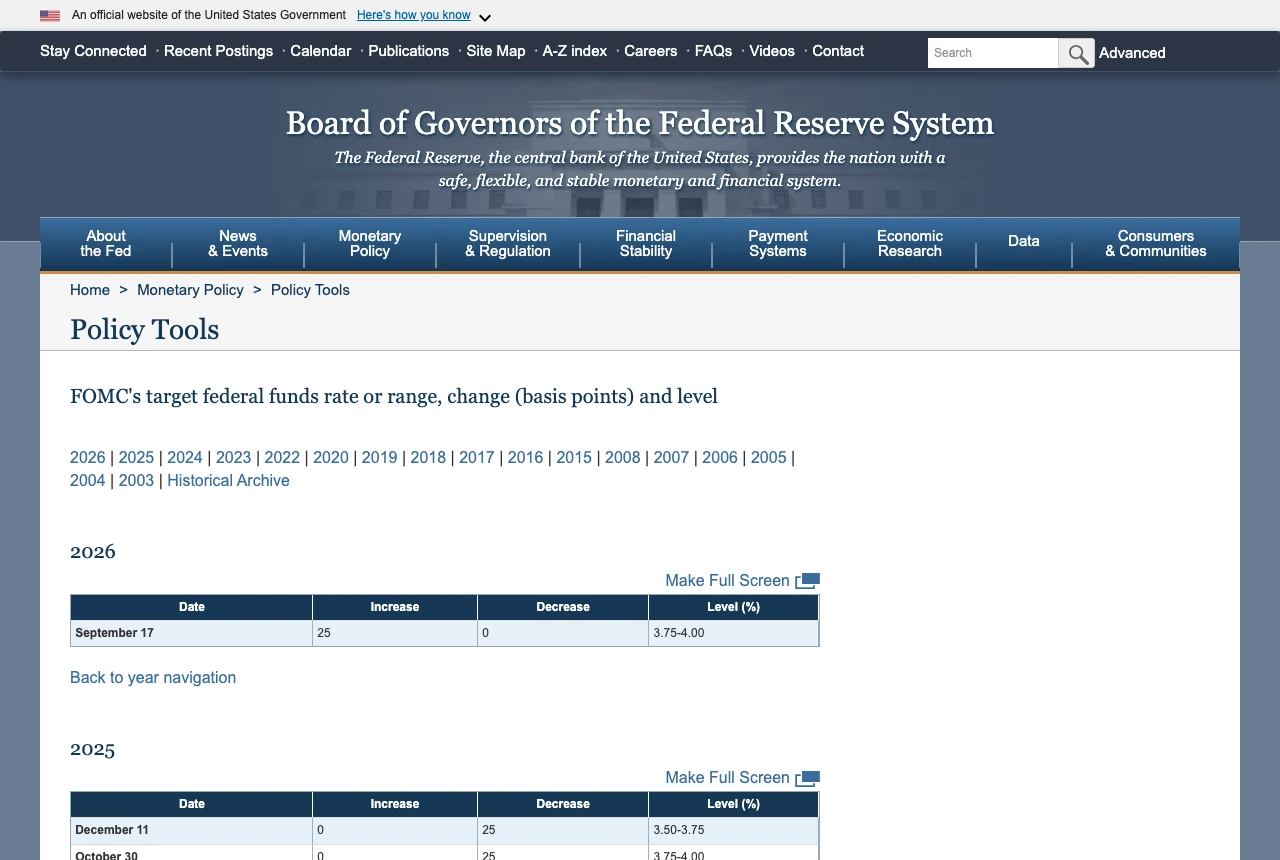
| Six months of US interest (midpoint of the 3.75–4.00% federal funds range) | 3.875% × 0.5 = 1.9375% |
| Six-month forward | 0.6666 × 1.019375 ÷ 1.02425 ≈ 0.6634 |
| Cost of US$50,000 at spot today | ≈ A$75,008 |
| Cost of US$50,000 at the forward rate | ≈ A$75,366 |
Because the Australian dollar pays more interest than the US dollar, the forward buys slightly fewer US dollars than spot. The extra A$358 is the interest gap, not a prediction that the Australian dollar will fall. The US side of the sum comes from the Federal Reserve’s target range for the federal funds rate, raised to 3.75–4.00% in September 2026:
What the forward buys you is certainty. If the Australian dollar slides to 0.62 by May, buying the US$50,000 at spot would cost about A$80,645; if it climbs to 0.70, about A$71,429. With the forward, the bill is about A$75,366 either way. Real quotes use market interest rates for the exact period rather than official rates, and the provider adds its own margin, which is where most of the cost to you sits. Ask for that margin as a percentage of the mid-market forward, the same way you would for a spot transfer (bid, ask and the spread explains the idea). The same formula is why a currency carry trade stops paying once you protect it with a forward: the forward rate takes the interest gap back.
Spot, forward or an app’s guaranteed rate: how long each one holds the price
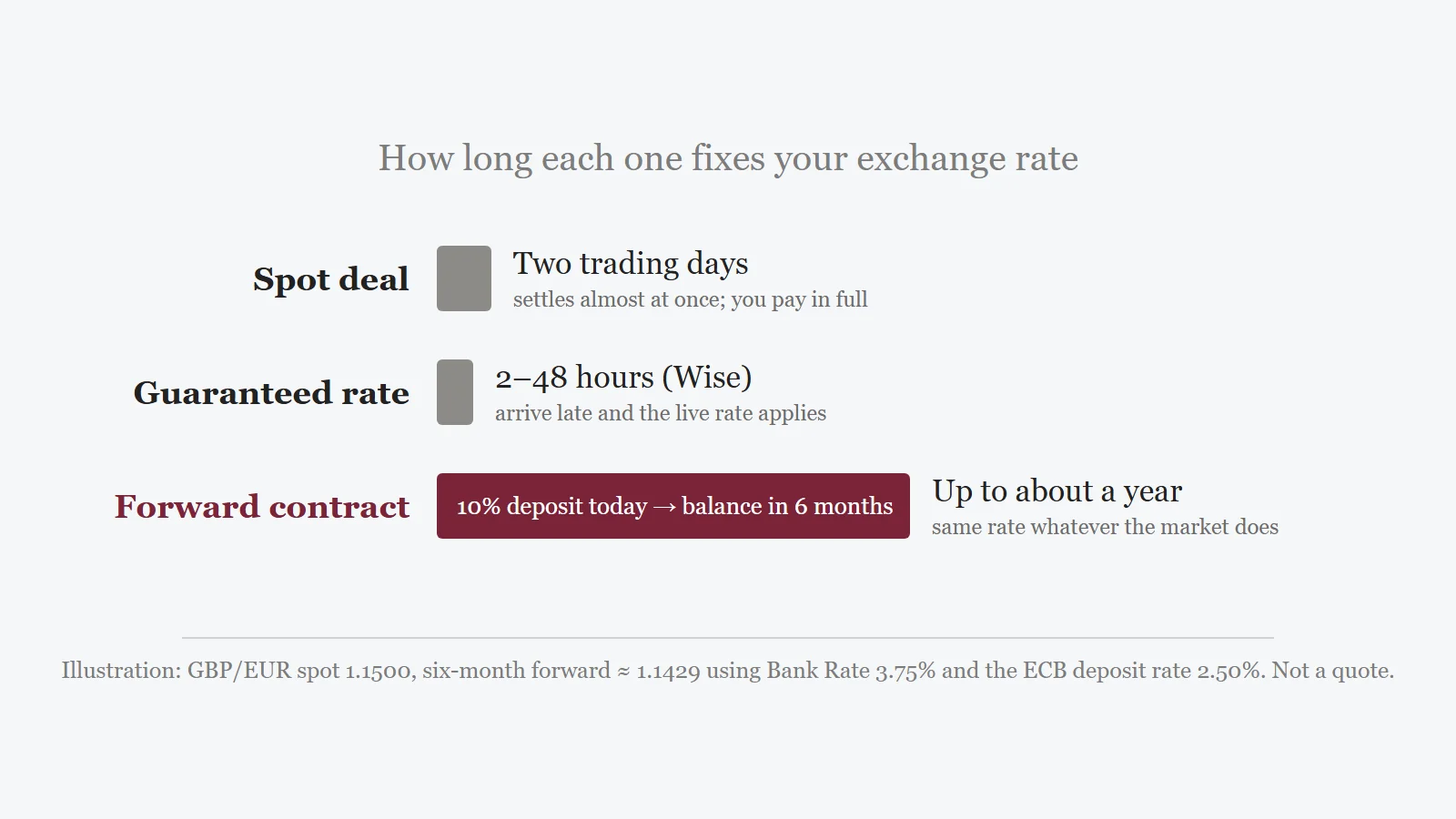
“Locking in” a rate can mean very different things. A guaranteed rate on a money-transfer app such as Wise or Revolut is not a forward contract. The table puts the three side by side.
| Spot deal | Guaranteed transfer rate | Forward contract | |
|---|---|---|---|
| How long the rate is fixed | Settles within two trading days | 2 to 48 hours at Wise, depending on the currency | Weeks to about a year at most providers |
| Deposit | None; you pay in full | None; you pay in full | Usually around 10% up front |
| If the rate moves in your favour | Not relevant | If your money arrives late, Wise uses the live rate instead | You still pay the agreed rate |
| Can you cancel? | Done once settled | The guarantee simply lapses | Only by settling any loss, often from the deposit |
Wise’s help page says its guarantee lasts “2–48 hours depending on the currency you’re sending”, and that if your money reaches it after that window, it uses the live mid-market rate at the time it receives the funds. That is useful for a transfer you are making this week. It is not a way to fix a rate for a payment in six months. For how the mid-market rate and the margin on top of it work, see why your rate differs from Google’s.
Is a forward contract worth it? Using one to hedge exchange rate risk
To hedge simply means to protect yourself against a rate move. Whether a forward is the right way to do that depends on the payment:
| Your situation | A forward is… |
|---|---|
| Large, fixed amount; firm date; budget cannot stretch (a property payment, school fees, a supplier invoice) | Usually a good fit |
| Date likely to slip (a purchase still in negotiation) | Possible, but allow for the cost of extending or closing early |
| Small amount, a few hundred dollars | Rarely worth it; the margin and admin outweigh the protection |
| No fixed date, you just want “a good rate” | Not the right tool; a rate alert, an order that converts automatically at a rate you set, or converting in stages fits better |
A forward also does not suit a payment that might not happen at all, because you are still bound to the contract. If a forward does not fit, the cheaper habit is the one in our best exchange rate checklist: compare the rate against mid-market, convert in two or three parts if the sum is large, and use a provider that shows its margin clearly. The exchange-rate margin calculator shows what a quoted rate is really costing you.
Deposits and top-ups: why you can’t walk away once the rate is fixed
Because the provider commits to deal with you at a fixed rate in the future, it wants protection in case you do not turn up. The usual arrangements are:
- A deposit. Smart Currency Exchange, for example, says that to secure a forward rate “you will need to provide a 10% deposit”, and that you can fix a rate for up to a year ahead. Terms vary between firms.
- Margin calls. Some providers ask you to top up the deposit if the market moves a set percentage against the rate you fixed. Ask what the trigger is and how quickly you would need to pay.
- No changing the rate later. Once you have fixed a rate you have made a legal agreement to trade at it, so you cannot switch to a better rate if the market improves. If the deal is cancelled, the provider closes the contract at the current rate and any loss is taken from your deposit, with the balance returned.
For most people the real risk is the date, not the currency. If a purchase is delayed, you may need to extend (“roll”) the contract, which can cost money, or close it early at whatever the market rate is that day.
Is the provider regulated? How to check before you pay a deposit
The rules depend on the provider’s regulator, and many regulators treat a forward that pays for real goods or services differently from a speculative contract. The UK’s Financial Conduct Authority is a clear example. Its guidance says a spot deal between two major currencies settled within two trading days is not a financial instrument, and that a forward entered into to pay for identifiable goods, services or a direct investment falls under a “means of payment” exclusion (it counts as paying for something, not investing). That is why firms offering these forwards under the FCA are usually authorised as payment or e-money institutions rather than investment firms.
That status has consequences. FCA-authorised payment and e-money firms must safeguard customer money, keeping it separate from their own (tighter safeguarding rules apply from 7 May 2026), but they are not covered by the Financial Services Compensation Scheme. Whatever the regulator, look the provider up on that regulator’s public register before you send a deposit: confirm the firm’s exact name, that its status is current, and that its permissions cover what it is selling you. Our guide to checking whether a broker or exchange is regulated walks through the main registers.
Forwards are not a niche product. In the Bank for International Settlements’ survey of currency trading, run every three years, outright forwards averaged $1.8 trillion a day in April 2025, 19% of all foreign-exchange trading. Much of that is companies covering exactly the kind of known future payment described here.
Six questions to ask before you sign
- What is your margin? Ask for the forward rate and the mid-market forward for the same date, and work out the gap.
- How much is the deposit, and when is the balance due? Check whether the balance must arrive before the provider releases the currency.
- What triggers a margin call? Get the percentage move and the deadline for topping up in writing.
- Can the date be moved? Ask what extending the contract costs, and whether you can take part of the amount early.
- What happens if the deal falls through? Ask exactly how a loss on cancellation is calculated and taken.
- Is the firm authorised? Check it on its regulator’s public register before sending any money, and keep the contract terms.
Red flags: when a “forward” is really a bet
A genuine forward for a household or small business ends with currency being delivered to pay a real bill. Think twice if a product sold to you as “locking in a rate” is settled only in the difference between prices, lets you choose to go up or down, offers leverage, or never asks what the money is for. That is a bet on price moves (a speculative derivative), closer to a CFD (contract for difference) than to a payment tool, with different rules and far higher risk; our guide to how leverage and margin work shows why. Treat any cold call about “currency opportunities” the same way.
Locking in a rate: a few more questions
How is a forward exchange rate calculated?
It is the spot rate adjusted for the interest-rate gap between the two currencies over the contract period: forward = spot × (1 + quote-currency rate × years) ÷ (1 + base-currency rate × years). The provider then adds its own margin.
Can I get out of a forward contract if the rate moves in my favour?
Not at the new rate. You have agreed to deal at the fixed rate, so a better market rate does not change what you pay. If you cancel, the provider closes the contract at the current rate and any loss is usually taken from your deposit.
How long can I fix an exchange rate for?
Most providers that offer forwards to individuals and small businesses let you fix a rate for up to about 12 months. Some offer longer, so ask; the further out you go, the more the date risk matters.
Does Wise let you lock in an exchange rate?
Only for a short time. Wise’s guaranteed rate lasts 2 to 48 hours depending on the currency. If your money arrives after that, it uses the live mid-market rate when it receives the funds. That is not a forward contract.
Is my deposit protected if the provider fails?
Usually not by a compensation scheme. Forward providers are often licensed as payment or e-money firms, which must keep customer money separate; under the FCA, for example, such firms safeguard funds but are not covered by the FSCS, the UK’s compensation scheme. Check the firm’s status on its regulator’s register before you pay a deposit.
Why is the forward rate different from today’s rate?
Because of the interest-rate difference between the two currencies over the contract period. It is a calculation, not a forecast of where the exchange rate is heading.
Read next
- Reserve Bank of Australia — Cash Rate Target: 4.85% from 4 November 2026 (checked November 2026)
- Federal Reserve Board — Open Market Operations: federal funds target range 3.75–4.00% from 17 September 2026 (checked November 2026)
- European Central Bank — euro foreign exchange reference rates: AUD/USD on 20 November 2026, worked out from the euro rates
- Federal Reserve Bank of New York — Measuring the foreign exchange basis (appendix): covered interest rate parity
- Bank of England — Summary of UK survey results 2025: definition of an outright forward
- Bank for International Settlements — OTC foreign exchange turnover in April 2025: outright forwards $1.8 trillion a day, 19% of turnover
- FCA Handbook — PERG 13.4: spot exclusion (Q31C) and means-of-payment exclusion for forwards (Q31G, Q31M)
- FCA — PS25/12: changes to the safeguarding regime for payments and e-money firms, in force from 7 May 2026
- Wise Help — What’s a guaranteed rate?: 2–48 hours
- Smart Currency Exchange — What is a forward contract?: 10% deposit, up to a year, cancellation from the deposit (one provider’s terms)
Last updated 23 November 2026. Interest and exchange rates are as published on or before that date. The forward rate in this guide is an illustration, not a quote.