The market that’s open all week but not all the time Sydney, Tokyo, London and New York: how the FX sessions overlap and when spreads tighten
Most people arrive at this question asking when the market is open. The more useful version is when it is deep, because depth, not the opening hour, is what sets the spread you end up paying. Currencies trade around the clock five days a week across four regional sessions that hand off to one another, and the handovers are where the behaviour worth knowing about actually happens.
On this page
- The quick version
- Open all week, but not always the same
- The four sessions
- The overlaps, and where liquidity is deepest
- What each session actually trades
- When spreads tighten and when they widen
- Daylight saving: why the hours you memorised shift twice a year
- What time does forex open on Monday where you live?
- The weekend gap
- Trading around news releases
- Converting vs trading: does timing matter?
- Timing mistakes to avoid
- Questions people ask
The quick version
There is no single building where currencies trade. The FX market is decentralized — a global network of banks and brokers — so it has no opening bell. Instead it runs roughly 24 hours a day, five days a week. The week opens early when Sydney comes online and closes after New York winds down on Friday. Across those days, four regional sessions hand off to one another: Sydney, Tokyo, London and New York. The busiest stretch is the London–New York overlap, when the most money is changing hands and spreads are usually at their tightest. Outside those peaks — and especially over the weekend, when trading stops entirely — conditions thin out. None of this predicts direction; it mostly affects how much a conversion costs to execute.
Open all week, but not always the same
A stock exchange has a front door that opens at a set hour and shuts at another. FX doesn’t. Because trading happens directly between institutions around the world, somewhere is always awake during the business week, so the market stays continuously open from the start of the week until Friday evening in New York. But “always open” is not the same as “always busy.” A currency pair behaves very differently at 3 a.m. in a quiet handover between regions than it does when two major financial centres are trading at once. The clock doesn’t change whether you can trade; it changes the conditions under which you do.
One practical note before the timetable: every session time below is given in UTC and is approximate. Financial centres shift with daylight saving at different times of the year, so the exact hours drift by an hour here and there. Treat the numbers as a map of the rhythm, not a precise schedule.
The four sessions
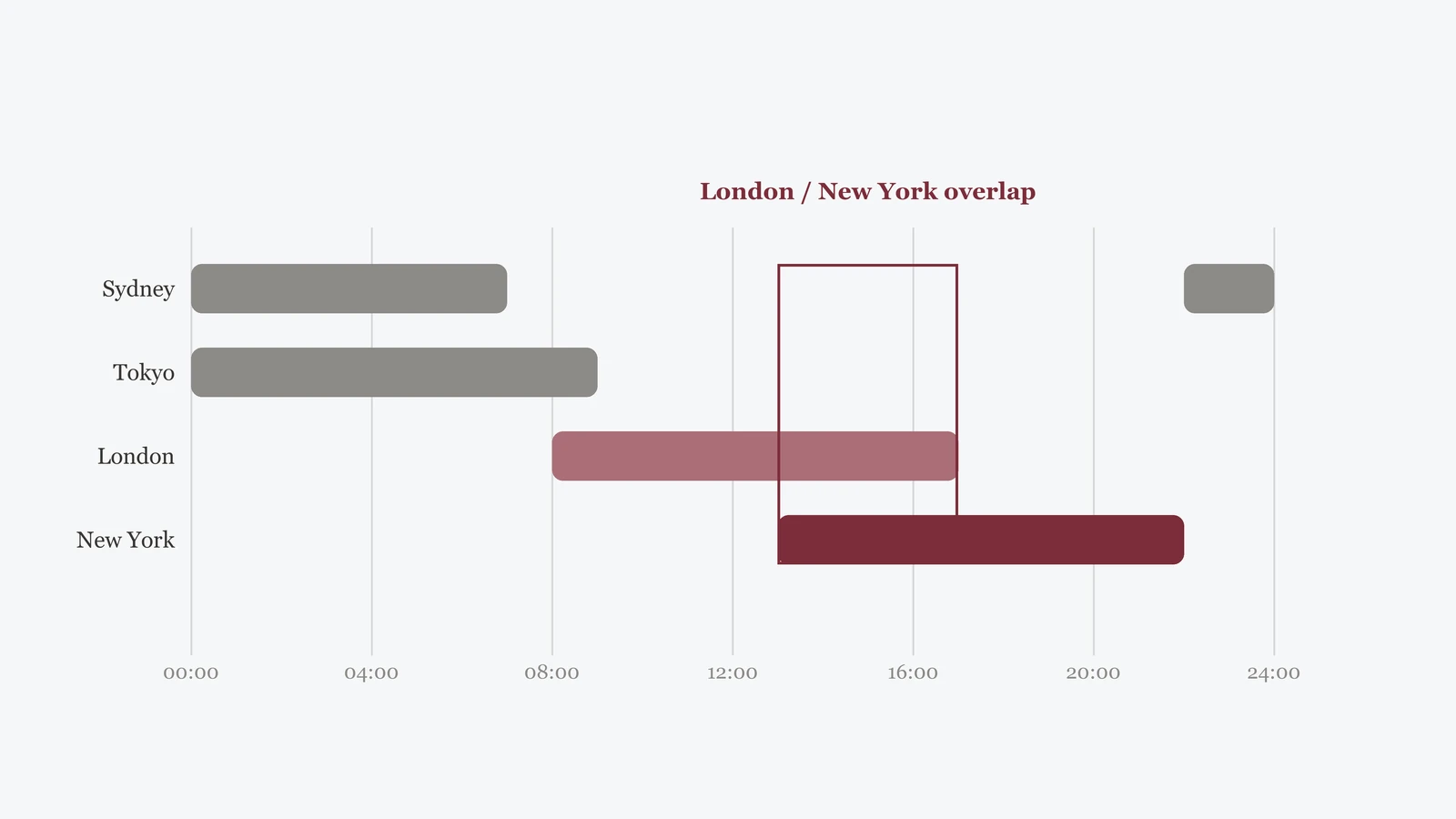
The trading week is usually described as four overlapping sessions, named for the financial centre that anchors each one. They flow westward around the globe: as one region’s working day ends, the next is beginning.
| Session | Approx. hours (UTC) | Character |
|---|---|---|
| Sydney | 21:00 – 06:00 | Opens the week; generally the calmest, thinner activity. |
| Tokyo (Asian) | 00:00 – 09:00 | Asian-hours flow; more active in yen and regional pairs. |
| London (European) | 07:00 – 16:00 | The largest single session; high volume across major pairs. |
| New York | 12:00 – 21:00 | Busy through the morning, then quietens into the close. |
Reading the table These windows are approximate and shift with daylight saving in each region. They overlap on purpose — the hours don’t hand off cleanly, and the overlaps are exactly where the action concentrates.
The overlaps, and where liquidity is deepest
The London–New York overlap is the deepest-liquidity, tightest-spread window of the trading day. The interesting moments are not the sessions themselves but the seams between them, when two centres are open at once. More participants trading simultaneously means more orders on both sides of the market — what traders call deeper liquidity. Two overlaps stand out:
- Tokyo and London share a short window as Asia’s afternoon meets Europe’s morning. Activity picks up, though it’s the quieter of the two overlaps.
- London and New York overlap for several hours when both of the world’s largest FX centres are trading at the same time. This is the deepest, most liquid stretch of the entire week — the period when the most money moves through major currency pairs.
If you ever read that “the market is most active in the early afternoon, London time,” this overlap is why. It isn’t a rule someone set; it’s simply when the most hands are on the same table.
What each session actually trades
Each session has a personality, and it comes from who is at their desk. A currency tends to be most actively traded when its home region is open, because that’s when the local banks, exporters and data releases are all live at once. Knowing which pairs come alive in which window explains a lot of why a chart looks sleepy one hour and jumpy the next.
The Sydney and Tokyo stretch is where the Asian day trades. The Australian dollar and New Zealand dollar are naturally more responsive here, and the Japanese yen does most of its work in Tokyo hours — yen crosses such as USD/JPY and EUR/JPY often set their tone before Europe wakes up. This is also when Asian economic figures land: Australian employment and inflation prints, Chinese activity data, Bank of Japan announcements. If a pair has an Asian leg, this is its home game.
London is the heavyweight. It is the single largest FX centre by volume, and when it opens the whole market tends to shift up a gear. The euro and the British pound are at their most active here — EUR/USD, GBP/USD and EUR/GBP all trade heavily — and because London straddles the boundary between the Asian and American days, a great deal of the week’s turnover passes through it. Much of what looks like “the market moving” on a major pair is really the London session doing what it does.
New York is the dollar’s session. Anything quoted against the US dollar — which is most major pairs — can pick up when America comes online, and this is when the US economic calendar fires: non-farm payrolls, inflation reports, Federal Reserve decisions. The first few hours, while London is still open, carry most of New York’s energy; once London closes for the day, activity tends to fade toward the New York close. So the liveliest pair at any given hour is usually the one whose home currency is trading — yen in Tokyo, sterling and euro in London, dollar-based pairs in New York — with the majors busiest of all when London and New York trade together.
A caveat worth keeping: “active” describes how much a pair moves and how often, not a promise of profit. A lively session simply means more participants and, usually, tighter spreads on that pair; it does not tell you which direction anything is going. If your pair is quiet at the hour you happen to be looking, that is often just the calendar — its home market is asleep — rather than a signal that something is about to happen.
When spreads tighten and when they widen
This is where the clock touches your wallet. The bid–ask spread — the gap between the price to buy and the price to sell — tends to be narrowest when liquidity is deepest, because lots of competing participants keep the two prices close together. So during the London–New York overlap, spreads on major pairs are typically at their tightest, and the cost of getting in and out is lowest.
The reverse is also true. In thin hours — late in the New York session, or the quiet stretch before Tokyo really gets going — fewer participants mean wider spreads and prices that can jump on relatively small orders. Holidays in a major financial centre can thin things out too, even on a weekday.
- Decide what you’re doing: a one-off conversion, or active trading where execution cost matters per transaction.
- If cost-per-trade matters, note which session you’re in — tighter spreads cluster around the busy overlaps.
- Check the live spread on the platform’s own screen before you commit; don’t assume it from the hour alone.
- Be wary of thin-hour quotes and of any pressure to act on a sudden “move” when the market is quiet.
Tighter spreads make execution cheaper; they say nothing about which way a price will go. A great spread on a bad decision is still a bad decision. Timing here is about cost, not direction.
Daylight saving: why the hours you memorised shift twice a year
The session times in the table are pinned to local market clocks, not to UTC. London opens when it is morning in London; New York opens when it is morning in New York. Those regions put their clocks forward in spring and back in autumn — but not on the same dates, and not every region does it at all. So the moment you translate a session into UTC, the number moves a few times a year, and for a couple of awkward weeks the regions are out of step with each other.
A worked example makes it concrete. Europe and North America change their clocks on different weekends in both spring and autumn. In the gap between those changes, the London–New York overlap can sit an hour earlier or later in UTC than it does the rest of the year. Meanwhile Tokyo, which does not observe daylight saving, stays put — so the Tokyo–London handover shifts underneath it. If you have memorised the overlap as “13:00 UTC,” you can find yourself an hour off for a fortnight without anything actually changing in the market.
The fix is not to memorise UTC at all. Anchor the sessions to a city clock instead — “the busy window is early afternoon London time” holds true year-round, because it moves with London. When you need the exact figure, read it off the platform, which already accounts for whatever the clocks are doing this week. Treat any fixed UTC timetable, including the one above, as a rough map that drifts.
This mostly matters to two kinds of reader. If you follow the market at the same clock time each day, a daylight-saving shift can make a normally busy hour look unexpectedly thin, or vice versa, until you adjust. And if you rely on a printed or half-remembered timetable, twice a year it will quietly be an hour wrong. Neither is dangerous on its own; both are easy to trip over. The habit that saves you is simple — think in city time, verify in the platform.
What time does forex open on Monday where you live?
Most retail platforms open the new week at about 5 p.m. New York time on Sunday, when Wellington and Sydney are starting their Monday, and close at about 5 p.m. New York time on Friday. On local clocks that lands at very different hours, and this autumn it moves twice, because the UK puts its clocks back on 25 October 2026 and the US a week later, on 1 November 2026.
| Your clock | Until 25 Oct 2026 | 25 Oct – 1 Nov 2026 | From 1 Nov 2026 |
|---|---|---|---|
| New York | Sun 17:00 | Sun 17:00 | Sun 17:00 |
| London | Sun 22:00 | Sun 21:00 | Sun 22:00 |
| Lagos | Sun 22:00 | Sun 22:00 | Sun 23:00 |
| Dubai | Mon 01:00 | Mon 01:00 | Mon 02:00 |
| Karachi | Mon 02:00 | Mon 02:00 | Mon 03:00 |
| New Delhi | Mon 02:30 | Mon 02:30 | Mon 03:30 |
| UTC | Sun 21:00 | Sun 21:00 | Sun 22:00 |
The Friday close sits at the same clock times, so in Dubai the week ends in the small hours of Saturday. Lagos, Dubai, Karachi and New Delhi don’t change their clocks; they only move in the right-hand column because New York does.
The busiest stretch moves with it. In London the New York session normally starts at 13:00; during the week of 25 October to 1 November it starts at 12:00, so anyone who converts or trades at a fixed London time will find the overlap an hour earlier than usual. The exact minute also varies a little between brokers, so check yours once rather than trusting any table, this one included. In MetaTrader 5, right-click the pair in Market Watch and choose Specification: the window lists the pair’s trading sessions for each weekday in the platform’s server time.
The weekend gap
For all its “around the clock” reputation, FX does close. Trading stops for the weekend after the New York session ends on Friday and doesn’t resume until Sydney opens the new week. During those roughly two days, you generally can’t trade most currency pairs at all.
The catch is that the world doesn’t pause just because the market does. News, elections and economic events still happen over the weekend. When trading reopens, the first prices can appear at a noticeably different level than Friday’s close — a jump with no trades in between. That jump is called a gap, and it matters most to anyone holding a position over the weekend, because the market can reopen past the level where they expected to act.
If you carry a leveraged position into the weekend, a Monday-open gap can move against you before you can do anything about it — there is no trading in the gap to step out at. And if anyone pressures you to “trade the news” during thin overnight or weekend-adjacent hours, treat that as a warning sign, not an opportunity. Spreads are wide and prices are jumpy exactly when it’s hardest to execute well.
Trading around news releases
Sessions are the slow rhythm of the week; economic releases are the sudden jolts inside them. Big scheduled figures — a central-bank rate decision, an inflation print, US non-farm payrolls — land at a fixed local time, and they cluster in the home session of the currency involved. US data hits during New York hours; euro-area and UK data during London; Australian and Japanese data during the Asian session. The calendar is public, so the timing is no surprise, even though the number is.
What happens in the seconds around a release is worth understanding even if you never intend to trade it. Liquidity can thin out just before the number as participants step back, then the price can gap and whip around for a few minutes as everyone reprices at once. Spreads often widen in that window — sometimes sharply — so the cost of getting in or out spikes at exactly the moment the screen looks most exciting. A quiet pair can travel a surprising distance before it settles.
None of that is a strategy, and this guide is not about how to trade the news. The practical takeaway is defensive: know when the major releases for your pair are scheduled, and recognise that the minutes around them are unusually expensive to transact in. If you are simply converting money, the same lesson applies in miniature — there is rarely any reason to hit “convert” in the thirty seconds after a big print, when spreads are at their widest. Let the dust settle first.
It also helps to know that not every release carries the same weight. A headline interest-rate decision or a key jobs figure can move a currency for the rest of the session; a minor, second-tier statistic may pass with barely a flicker. You do not need to track them all. Knowing the two or three big scheduled events for the week — and roughly when they land in your own time zone — is enough to avoid being blindsided by a burst of volatility you could simply have waited out.
Converting vs trading: does timing matter?
Here’s the reassuring part for most readers. If you’re simply converting money — paying for something abroad, sending a transfer, swapping holiday cash — you do not need to time the sessions. The amounts ordinary people convert are tiny next to wholesale volumes, and the difference a few hours makes to a major pair’s spread is usually negligible against the provider’s own margin. What costs you is the gap between the rate you’re given and the mid-market rate, not the minute on the clock. Compare providers, not hours.
Session timing earns its keep for active trading, where you pay a spread on every entry and exit and those costs compound. There, choosing liquid hours over thin ones is a genuine, repeatable saving. The distinction is worth holding onto: timing is a trading concern about execution cost, not a conversion concern about direction.
This around-the-week-but-not-around-the-clock rhythm is also the natural setup for a contrast we draw elsewhere: the crypto market never closes, with no sessions and no weekend gap. Whether that’s an advantage or just a different set of trade-offs is the subject of a separate guide.
Timing mistakes to avoid
The quiet hours are a trap that looks like the opposite of one. Late at night the tape is calm, and calm reads as safe; what you are actually looking at is thin participation, wider spreads and prices that jump rather than drift. The market being open has never meant it is a sensible moment to act.
The weekend version is that same misjudgement stretched across two days. “I will just close it Monday” quietly assumes Monday opens near where Friday closed, and the entire point of a gap is that it is under no obligation to. If you are holding anything across a weekend, decide what happens to it before Friday evening rather than after Sunday night.
Questions people ask
Is the forex market really open 24 hours?
Roughly 24 hours a day, but only five days a week. It opens early in the week with Sydney and closes after New York on Friday, then pauses over the weekend before reopening. On most platforms that means about 5 p.m. New York time on Sunday to about 5 p.m. New York time on Friday, which is 22:00 in London for most of the year; the table above converts it to other cities.
What is the best time to trade?
For execution cost, the London–New York overlap usually offers the deepest liquidity and tightest spreads on major pairs. That’s a statement about cost, not a prediction about which way prices will move.
Do I need to time the sessions just to convert money?
No. For ordinary conversions the provider’s margin dwarfs any hour-to-hour difference in the spread. Focus on the rate against the mid-market rate, not the clock.
Why do the session hours in different sources not match?
Because they’re approximate and shift with daylight saving in each region. Different sources round the windows differently. Use them to understand the rhythm, then check the live market for exact conditions.
Is there a worst time to convert money?
The thin hours are the ones nobody much wants: the gap after New York winds down and before Asia gets going, and the minutes either side of a major scheduled release. Spreads widen in both. For an ordinary conversion this is a small effect next to the provider’s margin, but if you have a free choice, converting inside a busy session rather than a quiet one costs slightly less for no effort at all.
If crypto never closes, why does FX bother stopping?
Because the FX market is built on banks, and banks keep business hours in their own regions. The weekend gap follows from that: the market stops with a last price on Friday and reopens on Sunday wherever two days of news have left it. A market that never closes removes the gap and replaces it with the ability to move sharply while you are asleep, which is a trade-off rather than a straight improvement.
- Bank for International Settlements — Triennial Survey of global FX market structure and turnover: bis.org
- European Central Bank — foreign-exchange operations and reference rates: ecb.europa.eu
- Federal Reserve — background on the US dollar and foreign-exchange markets: federalreserve.gov
- UK government — when the clocks change in 2026 and 2027: gov.uk
- NIST — US daylight saving time dates for 2026: nist.gov
Last updated 29 September 2026. This guide explains how FX trading hours work; it is not investment, tax or legal advice. The local opening times are worked out from the 2026 clock-change dates published by the UK and US governments.