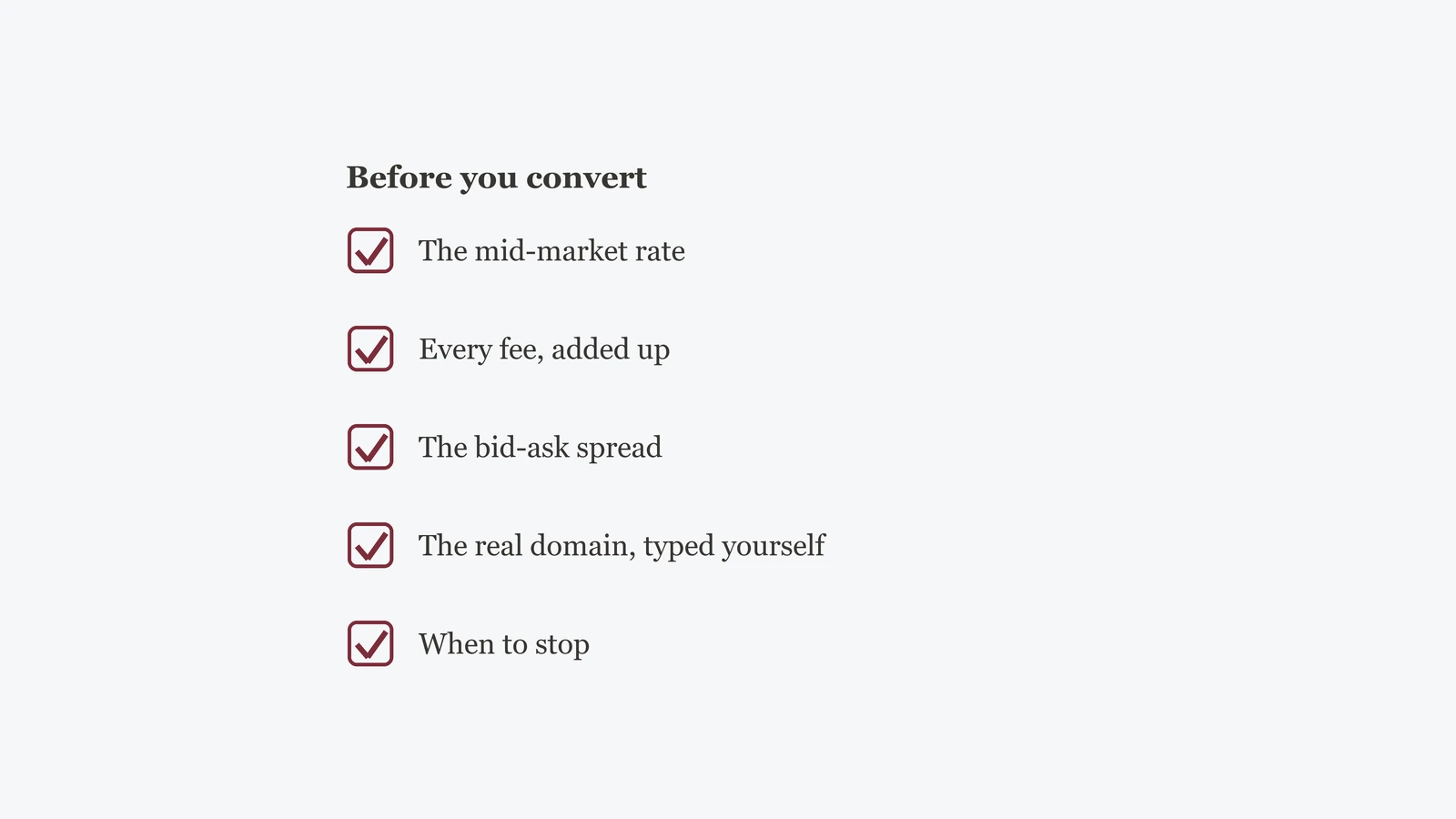
Get the best rate, avoid hidden fees, and convert safely — step by step A plain checklist for converting money or signing up anywhere: rate, spread, fees, domain, and when to stop
This page is for the moment right before you act: you’re about to convert money or open an account at a bank, an app, a broker or an exchange, and you want one last check before you commit. It’s a practical list you can run in a couple of minutes: read the rate, read the fees, confirm you’re really where you think you are, and know the signs that mean stop. Every step is something you can verify yourself on the provider’s own page — deliberately, because the point is to leave you able to judge any provider rather than to send you to one.
On this page
- The 20-second version
- The rate and the true cost
- The spread and the fees
- The provider and your safety
- When to stop
- How to verify a site’s real address
- The three places your money leaks
- Get the best rate, step by step
- Method by method: which to use when
- Sending money abroad without overpaying
- Before you open any account
- A worked comparison: $2,000 three ways
- Red flags a service isn’t legit
- Questions people ask
The 20-second version
Four checks before you press the button: know the true cost by reversing the all-in figure from the mid-market rate; read both the spread and the fees, not just one; confirm the provider and your own safety by checking the real web address and refusing to share secrets; and recognise when to stop. If anything is rushed, hidden, or asks you to pay up front to unlock money that’s supposedly yours, walk away. The whole list takes about as long as reading this paragraph twice.
The rate and the true cost
The headline rate is rarely the whole story. The number worth comparing is what your money is actually worth at the honest midpoint, and how far the offer sits from it.
- Find the mid-market rate for your pair from a neutral source, and note the time. Rates move every second.
- Reverse the all-in figure from the mid. Take the exact amount of the target currency you’ll receive, after every fee, and compare it to what the mid-rate would have given you. The gap is your real cost. The method is laid out step by step in the mid-rate and the margin.
- Compare like for like. Same pair, same amount, same moment. A quote from this morning isn’t comparable to one from now.
- Express the cost as one percentage so a bank, an app and an exchange land on the same scale. “No fee” tells you nothing until you know the rate.
The spread and the fees
On a broker or exchange there are two prices at once, and the distance between them is its own cost. Read both the spread and any separate fee, because together they decide what you really pay.
- Read both numbers. A flat or percentage fee is visible; the spread is quieter. Add them, don’t pick one. A small fee at a tight spread can beat “no fee” at a wide one.
- Understand what the spread is. The buy and sell prices straddle the mid; the wider that gap, the more it costs to get in and out. There’s a plain walk-through in bid, ask and the spread.
- Mind how the amount changes which cost matters. A flat fee barely registers on a large conversion but dominates a small one; a percentage spread does the reverse. The cheapest option for a small amount can be the priciest for a large one.
- Watch the edge cases. Thinly traded currencies, weekend or off-hours conversions, and “pay in your home currency” offers at a terminal usually carry a wider spread. Numbers like these are illustrative of the pattern, not a quote.
The provider and your safety
Pricing is only half the check. The other half is making sure you’re dealing with the real provider, on the real site, and that you never hand over the keys to your money.
- Verify the real domain yourself. Type the address into the bar by hand; don’t arrive through a link in an email, ad or message. A lookalike spelling or an extra word in the address is the oldest trick there is.
- Check whether it’s regulated and available where you live. Rules and access vary by country. A service that’s fine for someone abroad may not be licensed, or even legal, where you are. This is local rules, not advice.
- Never share passwords, 2FA codes, or a recovery or seed phrase. No legitimate platform asks for them; no official support agent will ask for your password, a one-time code, or your recovery phrase. Anyone who does is trying to take your money.
- Watch for “pay a release or unlock fee first” scams. Being told you must send money to free up funds that are supposedly already yours is a red flag every time, no matter how official the page looks.
Normal: a provider shows the all-in amount before you commit, lists fees plainly, and lets you take your time. A clear sign-up flow and a request to verify your identity to comply with the law are routine. None of that should rush you.
Anyone asking for your password, a 2FA or one-time code, or your recovery or seed phrase. Any demand to pay a “release,” “unlock,” “tax” or “activation” fee to access money that’s supposedly yours. Any “account manager” who messages you privately promising to grow your money. These are not pricing quirks; close the page.
When to stop
Some signals mean the answer is simply no, whatever the rate looks like.
- Pressure to decide now. Countdown timers, “this rate expires in two minutes,” or a person urging you to hurry. A fair conversion survives you taking a breath.
- An all-in figure they won’t show. If you can’t see exactly how much you’ll receive before you commit, you can’t judge the offer. Treat a hidden total like a sale price with the original price covered up.
- Any up-front fee to access money that’s supposedly yours. Legitimate withdrawals don’t require you to pay in first.
- A request for a secret. The moment a password, code or recovery phrase is asked for, stop: that alone ends the transaction.
How to verify a site’s real address
This one habit prevents most account-takeover scams. It takes seconds.
- Type the address yourself. Open a fresh tab and enter the provider’s known web address by hand, or use a bookmark you saved earlier, never a link someone sent you.
- Check the address bar carefully. Read the full domain left to right and confirm the exact spelling. Watch for swapped letters, extra hyphens, added words, or an unusual ending tacked on after the real name.
- Don’t trust links in messages, emails or ads. A link can say one thing and point somewhere else. When in doubt, navigate from the address you already know rather than the one you were handed.
The three places your money leaks when you convert
Almost every bad conversion loses money in the same three spots. Learn to spot all three and you stop most of the bleed. Two of them are priced separately; the third is a trap you can decline outright.
- The rate margin. This is the big one, and it hides inside the exchange rate itself. The provider quotes you a rate a little worse than the true midpoint and pockets the difference: no line item, no receipt. It is the leak people never see because nothing on the screen is labelled “fee.” If you want the mechanics of why the rate differs from the mid, the sister page walks through it; for now, just know the margin is real money and it is usually the largest cost.
- The visible fee. A flat charge (say, a few dollars) or a percentage, shown plainly. It is the honest part of the bill, and it is the number people fixate on precisely because they can see it. Fixating on it is a mistake: a “no fee” deal with a fat margin costs more than a small fee at a tight rate.
- Dynamic currency conversion (DCC). The one you can refuse. Abroad, a card terminal or website offers to bill you in your home currency instead of the local one: “Pay in USD?” The rate baked into that convenience is typically dreadful, often 3–5% worse than paying in the local currency and letting your own bank convert. Always choose the local currency.
Add up the first two and you have the real cost of a conversion; the third you avoid by paying attention at the till. A quick way to sanity-check any offer: take the exact amount you’ll receive, reverse it back to a rate, and see how far that sits from the mid: the gap is the sum of every leak, whether the provider itemised it or not. The step-by-step arithmetic lives on the sister page, in how to measure the real cost.
The rate margin is usually the largest of the three, because it scales with the whole amount rather than sitting at a fixed few dollars, which is why the reliable instinct is to distrust any headline that leads with “fee-free” and to go straight to the received amount instead. For the conceptual half — exactly where the margin hides and why providers price it the way they do — see the sister page; the job here is simply to catch it every time.
Spot all three and you catch nearly every avoidable loss on a conversion.
How to actually get the best rate, step by step
There is no single provider that is cheapest for everyone, so “best rate” really means a short routine you run each time. It takes two or three minutes and it works the same whether you’re converting at a bank, an app, a broker or an exchange.
- Know the mid before you start. Look up the mid-market rate for your pair from a neutral source and note the time. Without it you have no reference point, and a “great rate” with nothing to measure against is just a claim. If you’re unsure where to find it, the sister page shows how to check the mid-rate yourself.
- Get the all-in received amount, not the advertised rate. Ask the one question that matters: exactly how much of the target currency lands in the account or in your hand, after everything? The advertised rate is marketing; the received amount is the bill. If a provider won’t show it before you commit, that tells you something.
- Match the method to the amount. A flat fee is trivial on a large sum and brutal on a small one; a percentage margin does the opposite. Converting $50, a “$2 flat” service that’s otherwise near-mid may beat a “no fee” one with a 3% margin. Converting $50,000, that flips. Work out where the crossover sits for your amount rather than assuming one method always wins.
- Refuse DCC: always pay in the local currency. When a terminal or checkout abroad offers to charge you in your home currency, decline. Pay in the local currency and let your own bank do the conversion at a rate that’s usually far closer to the mid.
- Don’t convert at the airport unless it’s an emergency. Airport and hotel bureaus price for a captive audience; spreads of 5–12% are common. If you need a small amount of local cash to land with, fine — convert the minimum, then use a cheaper method for the rest.
- For large amounts, get a live quote and compare two providers at the same moment. Rates move by the second, so a quote from this morning isn’t comparable to one from now. Pull the all-in received amount from two providers within a minute of each other and compare those two numbers directly. On a big sum, a fraction of a percent is real money.
- Keep a screenshot with a timestamp. Capture the quote you accepted and the time. If the amount that settles doesn’t match, you have evidence; and the habit of recording it makes you read the figure properly in the first place.
The crossover step is the one people get wrong most, so it is worth a concrete look. Picture two services for the same conversion: one charges a flat 5 dollars and lands you on a near-mid rate; the other charges nothing but bakes a 2% margin into the rate. On 100 dollars, the flat-fee route costs 5 dollars and the “free” route costs 2, so the free one wins. On 1,000 dollars, the flat fee is still 5 while the 2% margin is now 20, so the flat-fee route wins by a mile. Somewhere around 250 dollars the two cross over. You do not need to find the exact crossover; you just need to know which side of it your amount sits on, and that flips the “obvious” answer more often than people expect.
A note on timing, since it trips up otherwise careful comparisons. Because rates move constantly, the only fair comparison is two all-in quotes pulled within moments of each other. Half an hour apart, a genuine market move can be larger than the fee difference you are trying to measure, and you end up choosing on noise. If you cannot get both quotes at once, at least note the mid at the moment of each and adjust for the drift — or just re-quote the first provider so both sit at the same instant.
One habit worth building for anything above pocket money: write the received amount down before you confirm, not after. The reconciliation habit treasury teams rely on, matching the figure you accepted against the figure that settled line by line, catches more errors than any single clever trick. You do not need a spreadsheet for a holiday transfer, but a screenshot with the time on it turns a vague “that felt like a bad rate” into a number you can actually check.
Run this often enough and it stops being a checklist and becomes reflex: you’ll glance at an offer, know roughly where the mid is, and spot an outlier without doing arithmetic.
Method by method: which to use when
The cheapest way to move money depends entirely on what you’re doing with it. Spending on a card, pulling out cash, shifting a lump sum and sending to another person are four different jobs, and the wrong tool for one is the right tool for another. The table below is a starting map; the figures are typical and illustrative, not quotes, and every one shifts with your provider, country and amount.
| Situation | Best method | Why | Avoid |
|---|---|---|---|
| Spending on a card abroad | A card with no or low foreign-transaction fee, billed in the local currency | Networks convert near the mid; a good card adds little on top. Foreign-transaction fees are often ~1%–3%, and some cards charge nothing. | DCC at the terminal (“pay in your home currency”), which typically costs ~3%–5% more. |
| Taking out cash abroad | A bank or fintech card with low ATM and FX fees, withdrawing local currency in fewer, larger amounts | Fewer withdrawals means fewer flat ATM fees; paying in local currency dodges the terminal’s markup. | Airport and standalone bureau ATMs, DCC on the screen, and lots of small withdrawals stacking flat fees. |
| Converting a large lump sum | A specialist provider or your bank’s FX desk, after comparing two live all-in quotes | On big amounts the percentage margin dominates, so a tiny rate improvement outweighs any flat fee. A fraction of a percent is real cash here. | Accepting the first quote; converting at a bureau; assuming “no fee” means cheap. |
| Sending money to someone overseas | A money-transfer service quoted on the recipient’s received amount | The only honest comparison is what actually lands in their account, after transfer fee, margin and any intermediary charges. | Comparing headline fees alone; ignoring a poor rate; a route that converts twice (see below). |
| Holding multiple currencies | A multi-currency account or app, converting when you choose | These usually convert near the mid with a small, visible fee, and let you hold a balance instead of converting round-trip. | Weekend or off-hours conversions at a wider spread; leaving idle balances where they attract charges. |
| Buying or converting on a crypto exchange | An exchange where you’ve read the live spread and fee for your amount first | Costs are the trading fee plus the spread; on liquid pairs both can be small, but you must check the real numbers before you trade. | Thin pairs with a wide spread; assuming “zero-fee” trading is free once the spread is counted. |
One pattern runs through the whole table: the visible price is rarely the whole price. A card’s foreign-transaction fee, a transfer service’s headline charge, an exchange’s “zero-fee” banner: each is only part of the cost until you add the margin sitting inside the rate. That’s the same reason a “zero fee” option can be the expensive one.
A few practical notes on reading the table, because the “best method” column shifts with your circumstances. The card rows assume you have a card worth carrying; if your only card charges 3% on every foreign purchase and adds DCC on top, a cheap prepaid travel card or a multi-currency app can beat it outright for a trip. The cash rows matter most in places where cards are not widely accepted — then the question becomes how to get local notes with the fewest flat fees, which usually means one larger ATM withdrawal rather than several small ones. And the lump-sum row is where the effort pays back hardest: on a house deposit or a tuition payment, spending ten minutes to pull two live quotes can be worth more per hour than almost anything else on this page.
The last row deserves a word of caution rather than a recommendation. A crypto exchange can convert between currencies at a spread that is tight on liquid pairs, but the cost is only knowable once you read the live trading fee and the spread for the exact amount you intend to move — and availability, and whether the whole thing is even permitted, vary by country. Nothing about a “zero-fee” trading tier changes the fact that the spread is still a cost. If an exchange is genuinely your best route, treat it like any other provider on this table: check the real numbers first, on the provider’s own page, before you commit a cent.
Sending money abroad without overpaying
An international transfer has more moving parts than a straight conversion, and each part is a place to overpay. Before you send, know what you’re actually being charged for.
- The transfer fee is the visible charge, flat or percentage, shown up front.
- The rate margin is the quieter cost, baked into the exchange rate the same way it is anywhere else. This is usually where the real money goes.
- Correspondent-bank fees can appear on old-style bank wires (SWIFT), where intermediary banks in the chain each take a cut before the money arrives — sometimes deducted from the amount your recipient receives, so it’s smaller than you sent.
- A speed premium often applies: instant delivery frequently costs more than a transfer that settles in a day or two. If it isn’t urgent, the slower option can be meaningfully cheaper.
To compare services honestly, ignore the headline fee and work backwards from the recipient. Take the exact amount that will land in their account, reverse it against the mid-market rate, and you get the true all-in cost of the whole route — fee and margin and any deductions along the way, folded into one number. Two providers with identical “$5 fees” can deliver very different amounts once the rate is counted.
Watch for a route that converts twice. If your money changes currency to an intermediate one and then again into the recipient’s, you can pay a margin at each hop: two bites out of the same transfer. A path that converts once, directly into the destination currency, usually wins. And confirm the delivery method before you send: a bank deposit, a cash pickup and a mobile-wallet credit can carry different fees and different rates, and the “best” one for your recipient depends on how they’ll actually collect it.
Two services can advertise the same headline fee and still deliver very different amounts, because the gap hides in the rate rather than the fee — so the only fair comparison is the received amount reversed against the mid. The step-by-step method is on the sister page, in how to measure the real cost.
Speed and delivery method are where the last few percent hide. Instant transfers often carry a premium over a one-to-two-day option, so if the money is not urgent, the slower rail can be meaningfully cheaper for the same route. And the way your recipient collects it changes the maths: a deposit straight into their bank account, a cash pickup at a counter, and a top-up to a mobile wallet can each carry a different fee and a different rate, even through the same provider. Ask the person on the other end how they actually want to receive it before you optimise for a number that assumes a delivery method they cannot use.
Two habits keep an international transfer honest. Confirm before sending that the route converts only once, directly into the destination currency; a path that hops through an intermediate currency can charge a margin at each conversion, and two small-looking margins add up to one large one. And on anything sizeable, send a small test amount first, confirm it lands as quoted, then send the rest — the same test-amount discipline from the pre-signup pass below, applied to money already in motion.
The recipient’s received amount is the whole game. Quote every service on that single figure, at the same moment, and the cheapest route stops being a guess.
Before you open any account — including an exchange
Whether it’s a bank, a transfer app, a broker or a crypto exchange, the sign-up moment is when people skip the checks they’d normally run. Here’s a short safety pass to make first — a couple of minutes that saves the expensive kind of mistake.
- Confirm the real domain. Type the address into the bar yourself and read it left to right. A lookalike spelling or an extra word tacked onto a familiar name is the classic setup; a link from an email or ad is exactly what you don’t trust here.
- Check what fees and spread apply to your amount, not the marketing average. A pricing page written for a $10,000 trade tells you little about converting $200. Find the numbers for your actual size.
- Read the provider’s own live figures before you commit. Rates, fees and availability change constantly and differ by country, so the real page beats any summary — including this one.
- Start with a small test amount. Move a token sum first, confirm it arrives as expected, and only then send the real money. Cheap insurance.
No legitimate platform or support agent will ever ask for your password, a 2FA or one-time code, or your recovery or seed phrase — anyone who does is trying to take your money. And never pay an upfront “release,” “unlock,” “tax” or “activation” fee to access funds that are supposedly already yours. Real withdrawals never work that way. Either one means stop and close the page.
It helps to know what a normal sign-up actually looks like, so the genuine steps don’t spook you and the fake ones stand out. Being asked to verify your identity with a document to satisfy the law is routine. Setting a password and turning on two-factor authentication is routine, and good practice. A provider showing you the all-in figure before you commit is exactly what you want. What is never routine: anyone asking you to read back a one-time code, share your recovery phrase, or pay a fee to “release” funds. The line is simple — a real service asks you to prove who you are; a scam asks you to hand over the keys.
This same pass applies if your next step is a crypto exchange. Verify the address, read the live spread and fee for your amount, keep your secrets to yourself, and move a small test amount first — then decide. If you do open an exchange account, the safest habit is the one that runs through this whole page: confirm every rate and fee on the provider’s own live page before you act, because that is the only figure that is actually binding.
A worked comparison: converting $2,000 three ways
The routine above is easier to trust once you watch it run. Say you’re converting 2,000 US dollars into euros, and at the moment you check, the mid-market rate is 0.9200 — so at the honest midpoint your 2,000 dollars is worth 1,840.00 euros. Nobody hands you that figure; it’s the yardstick. Now put three ordinary routes side by side, each quoted on the one number that matters — euros that actually land — and reverse every cost back from the mid.
| Route (illustrative) | Rate used | Euros received | All-in cost | Cost vs mid |
|---|---|---|---|---|
| High-street bank, “no transfer fee” | 0.8925 | 1,785.00 | 55.00 | 3.0% |
| Multi-currency app, rate 0.9168 + €7 fee | 0.9168 | 1,826.60 | 13.40 | 0.7% |
| City-centre exchange bureau, “0% commission” | 0.8600 | 1,720.00 | 120.00 | 6.5% |
Read the last column, not the sales pitch. The bank charges no visible fee and still costs 55 euros, because the whole cut lives in a rate set 3% below the mid. The bureau’s “0% commission” is the priciest route on the table: 120 euros gone into a rate nobody labelled. The app is the only one that names a fee out loud, and it’s far the cheapest: a 7-euro charge on a near-mid rate lands you about 42 euros ahead of the bank and 107 ahead of the bureau, on the very same 2,000 dollars. The one that advertises a fee wins; the two that advertise “free” or “0%” lose. That inversion is the entire point of reversing from the mid, and it is why the received amount — never the headline — is the figure to compare.
Treat the figures above as a worked method rather than a price list. Rates move continuously, and the same provider will quote you differently depending on the currency, the amount and the day. What survives is the procedure: run the three columns yourself at the moment you convert, and whichever route hands you the most euros is the cheapest, whatever its banner says.
Red flags that a conversion or brokerage service isn’t legit
Getting a fair rate assumes the service is real in the first place. Before you move money through any conversion, transfer or brokerage site — especially one you found through an ad, a message or a stranger’s recommendation — run this quick honesty check. Any single item below is reason enough to close the tab.
- No licence or regulator named. A legitimate broker or money service states who regulates it and its licence number, and you can look that number up on the regulator’s own site. Vague claims to be “fully licensed” with nothing to check are worthless.
- Pressure to deposit fast. Countdown timers, a “bonus” that expires tonight, or a person urging you to fund the account this minute. Real services are happy to wait; urgency is a tool for stopping you from thinking.
- Anyone asks for remote access. A request to install AnyDesk, TeamViewer or similar so someone can “help you set up a trade” or “fix a problem” means they want control of your screen and your accounts. No genuine provider needs it.
- Extra fees to withdraw your own money. Being told you must pay a “release,” “tax,” “insurance” or “unlock” fee before funds that are supposedly yours can be released. This is the signature of a scam; real withdrawals never work that way.
- A rate far off the mid with no explanation. A quote well away from the mid-market rate, on a common pair, with nothing said about why. A wide margin on an exotic currency or a weekend has a reason; a wild rate on EUR/USD at midday does not.
- No real address or company details. No registered company name, no physical address, no proper contact route — only a chat window and a phone number. If you can’t tell who you’re dealing with or where they are, you can’t recover anything when it goes wrong.
None of these on their own proves fraud in every case, but each is a reason to slow down, and any two together are a reason to walk away entirely. The safe move is always the same: leave, reach the provider through an address you typed yourself, and never send money to unlock money. If a site fails this check, no exchange rate it offers is good enough to matter.
Questions people ask
What’s the single most important check?
That you’re on the real site you intended to use. A great rate on a fake page is a trap. Verify the address by hand first, then compare the cost.
How do I know if a fee is fair?
There’s no universal number — it depends on the currencies, the amount and the method. Instead of guessing a threshold, reverse the all-in figure from the mid-rate and compare a couple of providers on the same scale. The outlier reveals itself.
A support chat asked me to confirm my 2FA code to “secure my account.” Is that normal?
No. No legitimate platform or support agent will ever ask for your password, a one-time code, or your recovery phrase. Stop and contact the provider only through its own site, which you reach by typing the address yourself.
Does this list apply to crypto exchanges too?
Yes — the same checks on rate, spread, fees, domain and safety apply. Add one check that only matters here: find out what it costs to get money back out before you put any in. Withdrawal charges are priced separately from trading commission, and they are the step people skip. Binance’s fee schedule shows how one venue lays that out.
What’s the single best way to save on currency conversion?
Compare on the all-in received amount, not the advertised rate. Look up the mid, then ask each provider exactly how much lands after every fee and margin. The one that delivers the most is cheapest — regardless of which one shouts “no fee.” That single habit catches most overpaying.
Is it cheaper to convert money at my bank or with a card?
It depends on your bank, your card and the amount, so there’s no fixed winner. A card with a low or zero foreign-transaction fee, billed in the local currency, is often cheaper for everyday spending; a bank or specialist desk can win on a large lump sum. Compare both on the received amount.
How do I avoid hidden fees when exchanging money?
The hidden cost is almost always the margin inside the rate. Reverse the amount you’ll receive back to a rate and see how far it sits from the mid — that gap is the fee nobody labelled. Read both the spread and any charge, and decline DCC abroad.
Should I convert cash before I travel?
Usually just a small amount, to have local currency on arrival. Avoid airport and hotel bureaus, where spreads of 5–12% are common. For the rest, a low-fee card billed in the local currency, or ATM withdrawals in larger amounts, tends to cost far less than converting a wad of cash up front.
How do I know a conversion rate is fair?
Measure it against the mid-market rate for that pair at that moment. If you can’t find the mid, you can’t judge the offer — treat a “great rate” with no reference point like a sale price with the original hidden. A fair rate sits close to the mid; the further off, the more you’re paying.
- U.S. Securities and Exchange Commission — investor education and fraud awareness: investor.gov
- European Securities and Markets Authority — warnings and consumer guidance: esma.europa.eu
- European Central Bank — euro foreign-exchange reference rates: ecb.europa.eu
Last updated 9 September 2026. This checklist explains how to compare conversions and spot common scams; it is not investment, tax or legal advice. The checks work with whatever the rates and fees are on the day you use them.