Why one broker says 1:30 and another says 1:500 Leverage limits by country, what each one does to the same deposit, and how to tell which rulebook your account is under
Open two broker sign-up pages side by side and you can find the same EUR/USD offered with a maximum leverage of 1:30 on one and 1:500 on the other. Neither broker is being generous or stingy. The number comes from the rulebook your account would sit under, and that depends on where you live and which company in the broker’s group signs you up. The gap matters more than it looks: at 1:30 a 3.3% move against a full-size position takes the whole deposit, and at 1:500 a move of a fifth of one per cent does.
On this page
The limits, side by side
For major currency pairs, the ceilings for ordinary retail clients look like this. They are the most a broker may offer you, not an amount you have to use.
| Where your account is | Major pairs | Other pairs | Where the rule comes from |
|---|---|---|---|
| UK | 30:1 | 20:1 | FCA rules, permanent since 1 August 2019 |
| EU | 30:1 | 20:1 | Measures ESMA agreed in March 2018, now carried by national regulators |
| Australia | 30:1 | lower | ASIC order in force since 29 March 2021, set to run to 23 May 2027 |
| United States | 50:1 | 20:1 | CFTC rule 17 CFR 5.9: minimum deposits of 2% and 5% |
| Offshore licences | often 500:1 | varies | Usually the broker’s own setting |
Two things in that table catch people out. The UK and EU numbers are identical because the FCA’s permanent rules were ESMA’s temporary European ones made permanent; Brexit did not change the ceiling. And the Australian order has an end date. ASIC extended it once, in 2022, to 23 May 2027. If you are reading this after that date, check ASIC’s site for what replaced it rather than assuming the table still holds.
Why the cap changes with what you trade
30:1 is only the top rung. ESMA’s 2018 measures set a ladder by type of underlying asset, and the FCA carried the same ladder into its rules:
- 30:1 on major currency pairs
- 20:1 on other currency pairs, gold and major stock indices
- 10:1 on commodities other than gold, and on smaller stock indices
- 5:1 on individual shares and anything else not listed
- 2:1 on cryptocurrencies
The logic is volatility. EUR/USD can go a week without moving two per cent. A single share can do that before lunch, and a cryptocurrency can do it while you read this paragraph. Each rung is set so that an ordinary bad day for that kind of asset does not empty the account in one go. So when a broker’s banner says “up to 30:1”, it is describing EUR/USD, not the bitcoin contract further down the same page. In the EU that contract would be capped at 2:1. In the UK it cannot be sold to a retail client at all: the FCA banned crypto derivatives for retail consumers from 6 January 2021.
The ratio also came with three protections that do as much work as the ratio itself. The broker has to close your positions once the money in the account falls to half the margin needed to keep them open. Your losses cannot run past the balance of the account. And the broker has to tell you, up front, what share of its retail accounts lose money.
The US works from deposits, not ratios
American rules never state a ratio. Under the CFTC’s rule 17 CFR 5.9, a dealer offering retail forex must collect a security deposit of at least 2% of a position’s value on major currency pairs and 5% on everything else. A 2% deposit is 50:1 leverage by another name, and 5% is 20:1. The National Futures Association, the industry body those dealers belong to, decides which currencies count as major and has to review that list at least once a year. The 2% figure only applies when both currencies in the pair are on it.
So a client in the US can be offered more leverage on EUR/USD than a client in London, 50:1 against 30:1. The trade-off is choice. Retail forex in the US goes through firms registered with the CFTC and the NFA, and that list is short.
Where 1:500 comes from
When its order took effect in 2021, ASIC described a retail client’s CFD exposure until then as being as much as 500 times the original outlay. That is where the familiar 1:500 comes from. It was the ordinary offer before the large regulators stepped in, and it is still the ordinary offer from firms licensed in places that have no comparable cap.
Plenty of brokers you will have heard of run more than one company: one licensed by the FCA or an EU regulator for clients there, and another registered elsewhere for everybody else. Which one you end up with depends mostly on the country you give at sign-up. The leverage figure on the website follows the company, not the brand on the logo, and so do the protections.
There is a second way to higher leverage inside the UK and EU: being classed as a professional client. The caps are written for retail clients. A broker can move you to professional status if you meet its tests, and with the higher leverage you give up the retail protections described above. Some brokers keep offering a few of them voluntarily. Ask which, in writing, before you agree.
One deposit under three different caps
The cap decides the largest position a deposit can open. Put 1,000 behind the largest position each cap allows, then let the price move against you:
| Leverage cap | Largest position from 1,000 | Cost of a 1% move against you | Move that erases the 1,000 |
|---|---|---|---|
| 1:30 | 30,000 | 300 | 3.3% |
| 1:50 | 50,000 | 500 | 2% |
| 1:500 | 500,000 | 5,000 | 0.2% |
At 1:500 a one per cent move costs five times the deposit. In practice the position is closed long before it gets there, and that is the point: the room between opening the trade and losing the whole 1,000 is a fifth of one per cent, a distance EUR/USD can cover in minutes after a surprise jobs figure. At 1:30 under UK, EU or Australian rules, the half-margin close-out would shut the same trade once losses reached 500, after a move of about 1.7%.
None of this obliges you to use the maximum. Your real leverage is the size of the position divided by the money in the account, and you choose the size. A 1:500 account holding a 10,000 position on a 1,000 deposit is running at 10:1. What the cap decides is how large a mistake the platform will let you make before anything stops you. The leverage and margin calculator works this out for whatever size you type in, and how leverage and margin work covers margin calls and stop-outs in more detail.
What happened when Australia cut 1:500 to 1:30
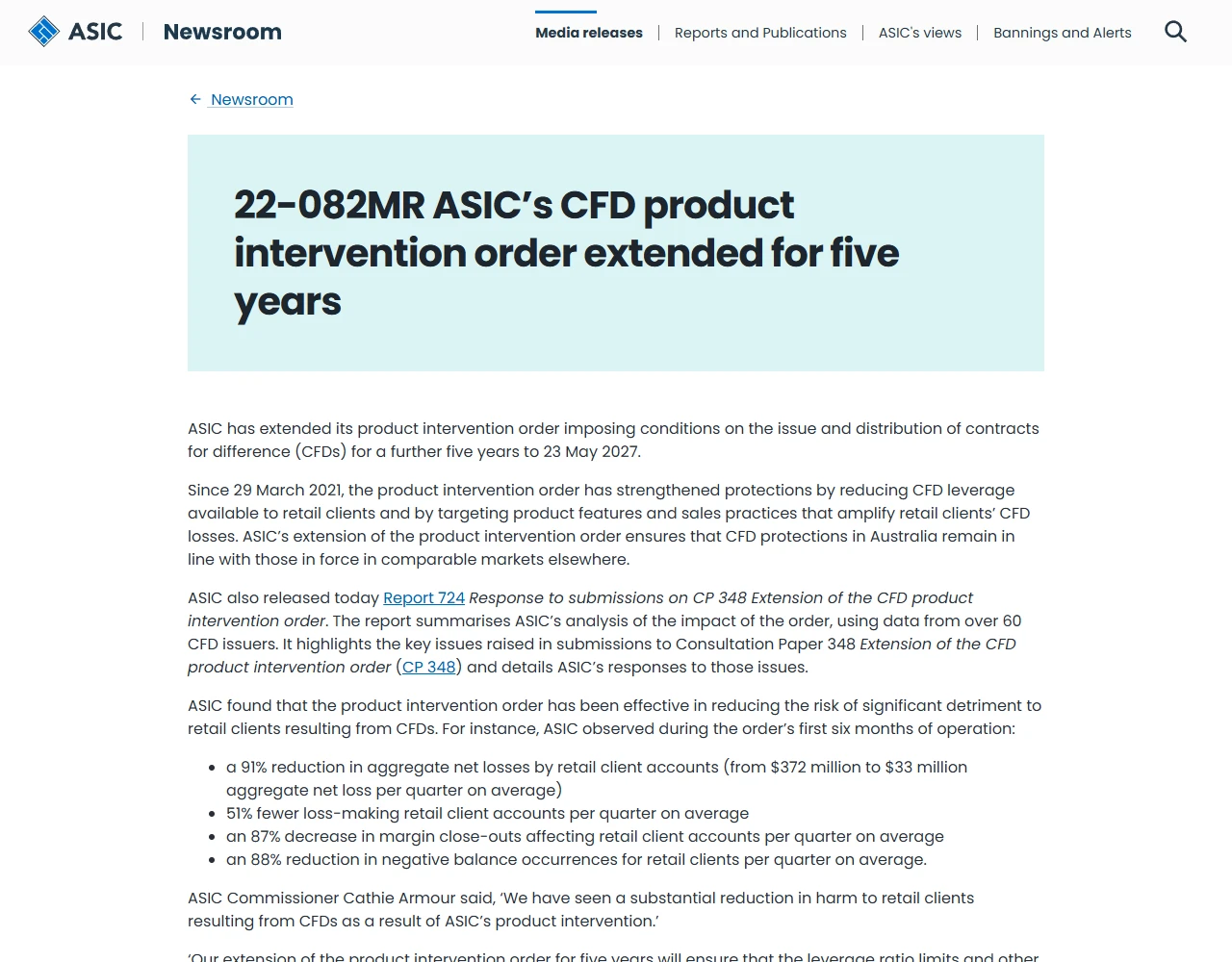
Australia is the cleanest test of whether the caps change anything, because the switch happened on one date and ASIC then counted the results using data from more than 60 CFD issuers. Over the order’s first six months, averaged per quarter and compared with before it:
- net losses across retail accounts fell 91%, from $372 million to $33 million a quarter
- 51% fewer retail accounts made a loss
- margin close-outs on retail accounts fell 87%
- retail accounts going into a negative balance fell 88%
Europe started from a similar picture. When ESMA agreed its measures in 2018, national regulators’ analyses showed that 74–89% of retail CFD accounts typically lost money. Lower leverage did not make trading profitable for most people. It made the losses smaller and slower, and it made a single bad afternoon less likely to be the end of the account.
Finding out which limit applies to you
The leverage you are offered is the quickest clue. Confirming it properly takes about five minutes.
- Find the name of the company you would actually contract with. It sits in the footer of the broker’s site and on the first page of the client agreement, usually as a limited company with a registration number, and it is often not the name on the logo.
- Look that company up on the register of the regulator it names. Checking a broker is regulated walks through the FCA, EU and ASIC registers step by step.
- Compare the maximum leverage you are shown on major pairs with the table at the top. More than 30:1 as a retail client in the UK, the EU or Australia means you are with a different company from the one those rules cover, or you have been classed as a professional client.
- Look for the risk warning that gives a percentage of losing accounts. UK and EU rules require it, so if it is missing, that tells you which company you are really dealing with.
These steps won’t tell you whether to trade; whether FX trading is worth it is a separate question. They tell you which protections you would have if you did.
Questions people ask
Is 1:30 leverage safe for a beginner?
No leverage is safe in the sense of being unable to lose money. 1:30 is the most a UK, EU or Australian broker may give a retail client on major pairs, not a recommended setting. Using a fraction of it, or none, keeps a bad trade from becoming a bad month.
Can I get more than 1:30 in the UK?
Only by opening an account with a company outside the FCA’s rules or by being reclassified as a professional client. Both routes remove protections that come with a UK retail account, including the rule that your losses cannot exceed your balance.
Why can US traders use 1:50 on major pairs?
US rules set a minimum deposit rather than a ratio: 2% of the position on major pairs, which works out at 50:1. Other pairs need 5%, or 20:1.
Does the same limit apply to crypto?
Crypto CFDs sold to retail clients in the EU are capped at 2:1, and in the UK they cannot be sold to retail clients at all. Crypto exchanges selling futures directly work under different rules and often offer far higher multiples; that says nothing about the risk being lower. FX vs the crypto market compares the two.
- European Securities and Markets Authority — the 2018 leverage ladder and the 74–89% loss figure: esma.europa.eu
- Financial Conduct Authority — permanent CFD rules for retail clients: fca.org.uk
- Financial Conduct Authority — ban on crypto derivatives for retail consumers: fca.org.uk
- Australian Securities and Investments Commission — order extended to 23 May 2027, with its measured results: asic.gov.au; and the 2021 release describing exposure of up to 500 times before the order: asic.gov.au
- 17 CFR 5.9 — US security deposits for retail forex: law.cornell.edu
Published 25 September 2026. The limits above are the ones in force for retail clients on that date; regulators revise them, and the Australian order is due to be reviewed by May 2027. This guide explains how leverage limits work; it is not investment, tax or legal advice, and it is not a recommendation to trade.