How much does a bank charge to change currency? Usually 2–4%, hidden in the rate What a 1%, 3% or 5% markup costs you in real money
Banks typically build 2–4% into the exchange rate itself and rarely print that figure. On 1,000 AUD, a 3% markup (the extra hidden in the rate) costs you 30 AUD, roughly 676 Thai baht or 656 Taiwan dollars at the reference rate on 23 November 2026, and that is an ordinary bank conversion. For any other amount, multiply the markup by the amount: at 1%, every 10,000 you convert costs 100 in the currency you start with.
CalculatorWork out the markup on a rate you were given →
On this page
1%, 3% or 5%: what each exchange rate markup costs you in money
A markup (the gap between the rate you are given and the reference rate, the wholesale market rate you see on Google or in a central bank’s daily list) costs the same share of whatever you convert. So the cost is in the currency you start with: 1,000 AUD at 3% costs 30 AUD, and 1,000 USD at 3% costs 30 USD.
| Amount you convert (AUD or USD) | 1% markup | 3% markup | 5% markup |
|---|---|---|---|
| 500 | 5 | 15 | 25 |
| 1,000 | 10 | 30 | 50 |
| 5,000 | 50 | 150 | 250 |
| 10,000 | 100 | 300 | 500 |
The same thing seen from the other side: this is how much less arrives when you convert 1,000 AUD into Taiwan dollars or 1,000 USD into Thai baht, using the reference rates on 23 November 2026 (1 AUD = 21.876 TWD, 1 USD = 33.943 THB).
| Markup | TWD for 1,000 AUD | THB for 1,000 USD |
|---|---|---|
| None (reference rate) | 21,876 | 33,943 |
| 1% | 21,658 | 33,604 |
| 3% | 21,220 | 32,925 |
| 5% | 20,783 | 32,246 |
Going from a 1% provider to a 5% one on 1,000 USD leaves you about 1,358 baht short. Rates move every day, so treat the converted figures as an example; the percentages hold on any day.
How to tell how much your bank is charging you
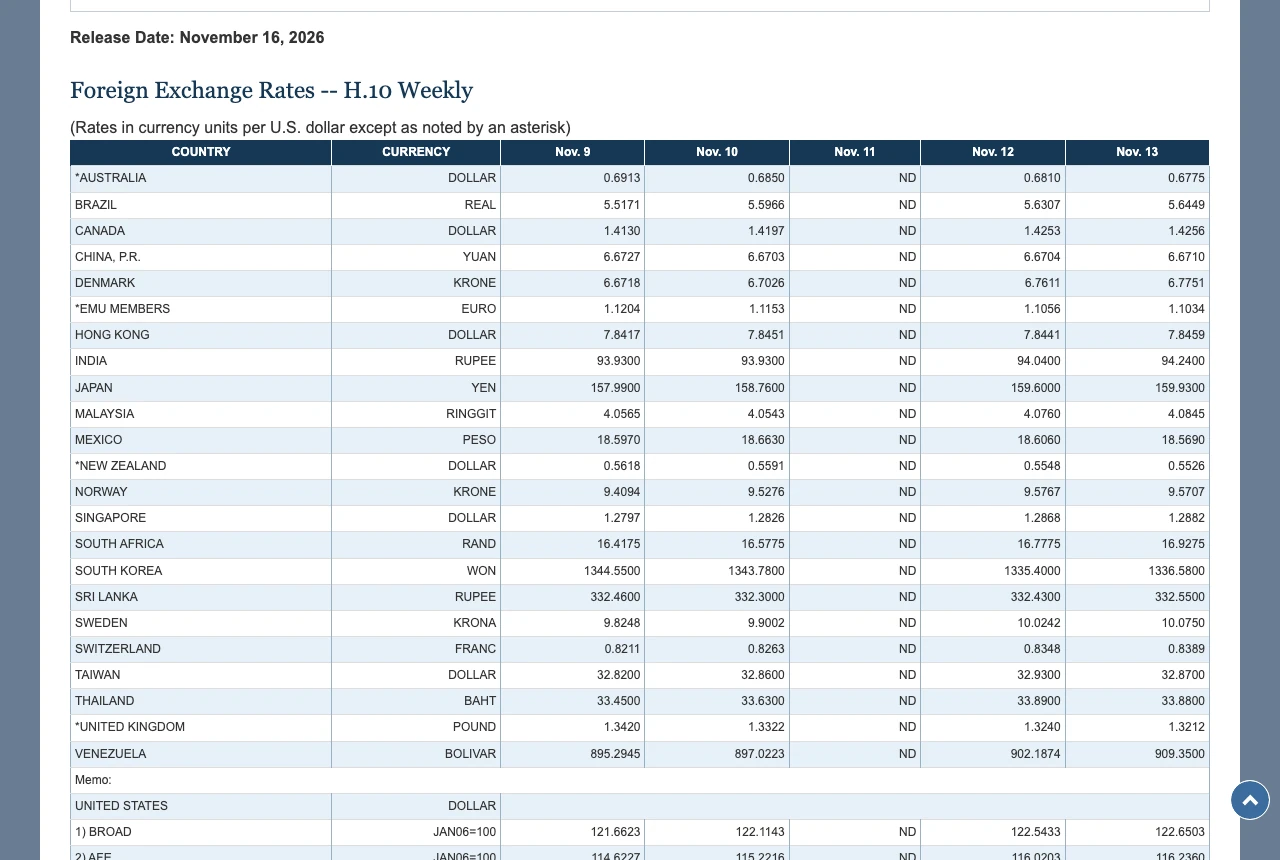
Banks rarely print their markup. You work it out by comparing their offer with a reference rate taken the same day. Free reference rates come from central banks: the European Central Bank publishes euro rates each working day, and the US Federal Reserve’s weekly H.10 release (a free table of exchange rates) lists a rate per business day for the US dollar against more than 20 currencies, including the Australian dollar, Thai baht and Taiwan dollar.
With a reference rate in hand, four steps give you the markup:
- Multiply your amount by the reference rate. This is what you would get with no markup.
- Ask the bank or app for the exact amount you will receive after every fee.
- Divide the amount you will receive by the figure from step 1.
- Subtract that from 1 and multiply by 100. The result is your total cost as a percentage, markup and fees together.
Say a bank offers 21,220 TWD for 1,000 AUD when the reference gives 21,876 TWD. 21,220 ÷ 21,876 = 0.970, so the markup is 3.0%, or about 30 AUD. Working from amounts received avoids a common trap: some quotes are written as AUD per TWD and some as TWD per AUD, but the money that arrives is always comparable.
If you’d rather not do the division, the exchange rate margin calculator takes your quoted rate and amount, compares them with today’s reference rate and shows the cost in money. A quote taken hours after the reference was set, or at the weekend, will differ a little even with no markup; how the mid-market rate works explains why, and why Google’s number is a reference rather than an offer.
A fixed fee weighs more on a small amount. A 5 AUD fee on 200 AUD adds 2.5% on top of any markup; on 5,000 AUD it adds 0.1%. That is why the four steps use the amount received after fees.
Banks vs cards vs transfer apps: typical charges for changing money
Where you convert matters more than any other choice. These are typical ranges for widely traded currencies as of November 2026, not official benchmarks, and less common currencies cost more everywhere.
| Where you convert | Typical markup over the reference rate | What to watch |
|---|---|---|
| Online transfer service or multi-currency app | Well under 1%, often 0.3–0.7% | A separate fee; wider at weekends |
| Card payment abroad, paid in local currency | Visa or Mastercard rate near the reference, plus a foreign transaction fee of often 1–3% | Some cards charge no foreign transaction fee |
| Bank transfer or bank counter | Often 2–4%, sometimes more | “No fee” offers with the cost in the rate |
| Airport kiosk or hotel desk, cash | 5–10% or more | “0% commission” signs |
Survey data points the same way. The World Bank’s Remittance Prices Worldwide database prices a 200 USD transfer, fees and exchange-rate margin together, across hundreds of country pairs. In its September 2025 report (data for the third quarter of 2025, the latest published when we checked in November 2026), the average across all providers was 6.36%. Banks were the most expensive type of provider at 14.99% of the amount sent, against 4.59% for digital transfer services. Those percentages are high partly because 200 USD is a small amount, so fixed fees count for a lot; on larger sums the gap is mostly the markup.
On cards, Visa and Mastercard convert at their own daily network rates, which are usually close to the reference. The extra cost comes from the foreign transaction fee charged by your card issuer (the bank behind your card), a separate percentage on each purchase in another currency. If a card terminal or ATM abroad offers to charge you in your home currency, say no: that option (dynamic currency conversion) lets the shop’s provider set its own rate, usually several percent worse. In the EU, card currency-conversion charges must be shown as a percentage markup over the latest ECB reference rate (Regulation (EU) 2021/1230, Article 4), so you can see the number before you pay.
Sending money abroad adds more layers on top of the markup, such as transfer fees and charges taken by banks along the way. What sending money abroad really costs walks through those, and how to get a better exchange rate lists the cheapest way to convert in each situation.
Why is the airport exchange rate so bad?
Airport and hotel exchange desks charge the widest markups because their customers have little choice: you have just landed, you need cash, and the next option is a taxi ride away. A few other things push the price up:
- Cash costs money to hold. A kiosk has to stock notes in many currencies, insure them and ship them, and some of those notes sit unsold for weeks.
- Rent and staff. Airport space is expensive, and counters are staffed through early and late flights.
- Small amounts. Most customers change a few hundred at a time, so the desk has to cover its costs on each small deal, and it does that through the rate.
- The sign hides the cost. “0% commission” or “no fee” is true, because the whole cost is inside the rate. The rate board usually shows a buy and a sell price far apart; the gap between them is the clue.
On 500 AUD, the step from a 1% card cost to a 7% airport counter is 30 AUD. If you need cash on arrival, change only enough for the first day and use a card in local currency or a bank ATM after that.
More questions about bank exchange charges
How much do banks charge for currency exchange?
Most banks build a markup of roughly 2–4% into the exchange rate, sometimes with a fixed fee on top. On 1,000 AUD that is about 20 to 40 AUD. These are typical ranges, not official figures, so check your own quote against the day’s reference rate.
How do I calculate the exchange rate markup on a quote?
Divide the amount you will receive by what you would get at the reference rate, subtract the result from 1 and multiply by 100. If 1,000 AUD should buy 21,876 TWD at the reference rate and you are offered 21,220 TWD, the markup is 1 − 21,220 ÷ 21,876 = 3.0%.
Is a foreign transaction fee the same as an exchange rate markup?
No. A markup is hidden inside the rate, while a foreign transaction fee is a separate percentage your card issuer adds to a purchase in another currency, typically 1–3% where it applies. On a card payment abroad you can pay both, so add them together.
Is “0% commission” currency exchange really free?
No. “0% commission” only means there is no separate fee; the cost is inside the rate instead. Compare the amount you will receive with the reference rate to see what you are really paying.
Read next
- Federal Reserve — H.10 foreign exchange rates release (release of 16 November 2026 shown above): federalreserve.gov
- Reference rates of 23 November 2026 used for the baht and Taiwan dollar figures: Rates By Exchange Rate API
- European Central Bank — euro foreign exchange reference rates: ecb.europa.eu
- World Bank — Remittance Prices Worldwide, September 2025 report (third-quarter 2025 data, checked November 2026): remittanceprices.worldbank.org
- EUR-Lex — Regulation (EU) 2021/1230 on cross-border payments, Article 4: eur-lex.europa.eu
Published 23 November 2026. Not investment, tax or legal advice: the aim is to show what a markup costs you and how to compare offers. The rates quoted are dated examples; the percentages work with the rates on any day.