Getting paid to hold a currency — until you’re not The carry trade, interest-rate differentials and swap, and why “free yield” reverses
You’ve probably read the pitch: hold the right currency and you earn interest just for sitting still. It sounds like money for nothing. There is a real mechanism underneath it — the carry trade — but there is also a catch that the pitch tends to skip. The catch is that the interest is only half of what you are holding. The other half is an open exchange-rate position, and that half has a long record of taking back months of accumulated yield in a matter of days. Both halves are below, in that order.
On this page
- The catch, up front
- Why two currencies pay different rates
- What the carry trade actually is
- Swap and rollover: the daily ledger
- The renting-cheap-money analogy
- Why it can work in calm markets
- The catch: when carry reverses
- How leverage magnifies both sides
- It is not free yield
- Where carry traders slip
- Questions people ask
The catch, up front
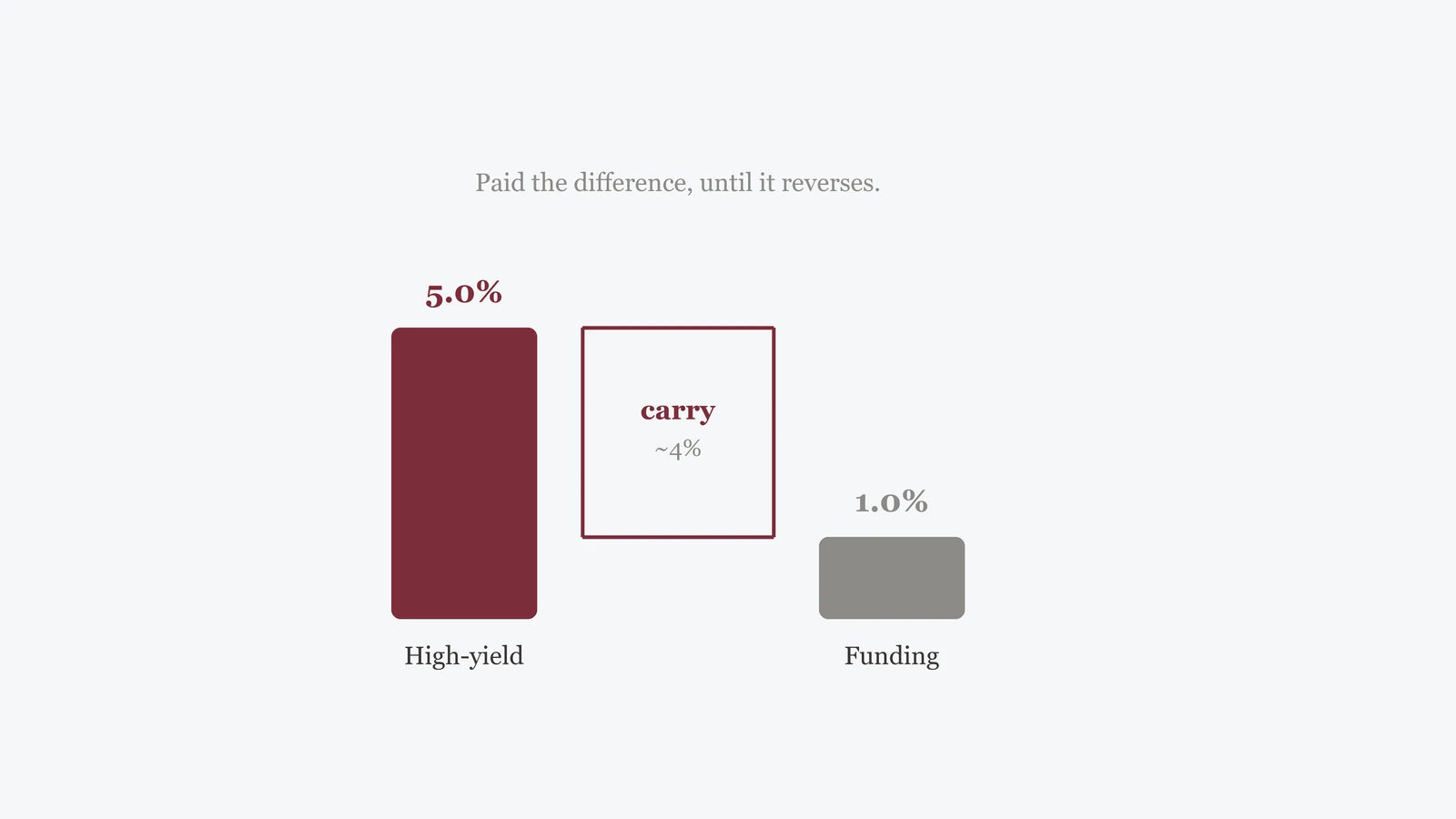
The carry trade means holding a higher-yielding currency funded by a lower-yielding one, and pocketing the difference in interest rates — the interest-rate differential. In a brokerage position you see this as swap (or rollover): a small amount paid or received each time you hold the position overnight. When markets are calm and the funding currency stays put, the differential trickles in. The trouble is that the same position carries currency risk: if the higher-yielding currency falls against the funding currency, the move can wipe out months of accumulated interest in days. It is a real strategy, not free yield, and it has a long history of sudden reversals.
Why two currencies pay different rates
The interest-rate differential is simply the gap between the short-term interest rates of two currencies — how much more one pays to hold than the other. Every currency is tied to a short-term interest rate set, broadly, by its central bank. Those rates are not the same everywhere, because each economy faces different inflation, growth and policy conditions. A central bank fighting high inflation may hold rates well above one that is trying to encourage borrowing. The gap between two countries’ short-term rates is the interest-rate differential, and it is the engine of the carry trade.
Because money in the wholesale market can be borrowed in one currency and lent in another, that differential becomes tradable. If one currency’s short rate is meaningfully higher than another’s, a position that is long the higher-yielding one and short the lower-yielding one earns roughly that difference over time — before any currency movement is taken into account. The two pieces, the yield you collect and the exchange-rate move you’re exposed to, are separate, and keeping them separate in your head is the whole point of this guide.
What the carry trade actually is
A carry trade is a position built to harvest that differential. You hold a higher-yielding currency and fund it by being short a lower-yielding one — the so-called funding currency. As long as the position stays open and the differential stays positive in your favour, you accrue the gap. Historically, traders have used low-rate currencies as the funding leg and rotated into whichever higher-rate currency offered the widest spread.
The crucial thing to notice is that you are not just earning interest. You are also holding an open currency position, which means you are exposed to where the exchange rate goes. The interest is the part people advertise. The exchange-rate exposure is the part that decides whether the trade actually made money.
Swap and rollover: the daily ledger
On a brokerage platform you rarely see the words “interest-rate differential.” You see swap, sometimes called rollover or overnight financing. Each day a position is held past the platform’s daily cut-off, the broker credits or debits a small amount that reflects the rate difference between the two currencies in your pair, plus the broker’s own markup.
- Positive swap: if you’re long the higher-yielding currency, you may receive a small amount each night.
- Negative swap: if you’re positioned the other way, you pay each night — and the same overnight cost works against you.
- Broker markup: the swap you actually get is not the raw differential. The platform usually keeps a slice, so the real number is smaller than the headline rate gap.
- Triple swap days: many platforms charge or credit several days’ worth on one weekday to account for the weekend, so the daily figure is not uniform.
Swap is where the carry trade meets your account statement. It is also where a position can quietly bleed if you’re on the wrong side of the differential, or if the broker’s markup turns a thin positive swap into a negative one.
To see the actual number before you hold anything overnight, look it up rather than work it out. In MetaTrader 5, right-click the pair in Market Watch and choose Specification. Swap long is what a buy position is credited or charged per night, Swap short is the same for a sell, and the swap rates line gives the multiplier for each weekday, which is where the triple day shows up. It is often a Wednesday, but each broker sets its own. Other platforms put the same figures on the instrument’s information panel, usually under a heading such as overnight funding. Read both sides: if Swap long and Swap short are both negative, the broker’s markup is bigger than the rate gap, and there is no carry to earn on that pair with that broker.
The renting-cheap-money analogy
Here is a currency-native way to picture it. Think of borrowing one currency cheaply — renting money where rent is low — and parking that money in another currency where it earns a higher rate. While the two rents stay where they are, you keep the spread between what you pay to borrow and what you earn to hold. That spread is the carry.
The carry is the rent you collect for holding the position. The exchange rate is the value of the thing you’re holding — and that value can fall faster than any rent comes in.
The analogy also makes the danger obvious. You are still holding an asset whose price moves. If the currency you parked your money in loses value against the one you borrowed, the drop in price can dwarf every cent of rent you collected. The rent is steady and small; the price move can be sudden and large.
Why it can work in calm markets
Carry tends to behave best in quiet conditions: stable interest-rate expectations, low volatility, and no scramble for safety. In those stretches, exchange rates can drift sideways or even move gently in the carry trader’s favour, so the differential accumulates with little drama. This is why carry has periods where it looks almost serene — a slow, repeatable trickle.
That calm is exactly what makes it seductive, and exactly what makes it dangerous. A long run of uneventful days lulls people into treating the yield as dependable and the currency risk as theoretical. The history of currency markets is full of stretches where carry worked smoothly for a long time and then unwound violently in a short one.
The catch: when carry reverses
The defining feature of the carry trade is asymmetry. The interest comes in slowly; the loss can arrive all at once. When markets turn “risk-off” — a shock, a policy surprise, a rush toward safer assets — crowded carry positions get unwound together. Everyone reaches for the exit in the same direction at the same time, the higher-yielding currency drops sharply against the funding currency, and the move can erase months of accumulated carry in a few days.
Here is an illustrative picture of that asymmetry over a holding period. These are made-up numbers to show the shape of the risk, not a forecast or a quote:
| Over the period (illustrative) | What carry pays | What an adverse FX move can cost |
|---|---|---|
| 3 months of calm, differential accruing | +1.5% | 0% |
| One risk-off week, higher-yielder falls 4% | +0.1% | −4% |
| Net result for the period | +1.6% earned | −4% lost |
The differential paid out for months; a single bad week more than reversed it. Illustrative, not a quote — the point is the shape, not the figures. This is the pattern carry has shown repeatedly: long, quiet accrual punctuated by short, sharp reversals.
Your total result is the carry you collect plus or minus the exchange-rate move — never the carry alone. Any pitch that quotes the yield without the currency exposure is showing you half the position.
How leverage magnifies both sides
Carry trades are often run with leverage, because the raw differential on an unleveraged position can look small. Leverage scales the position up, which scales the swap you receive — and scales the loss from an adverse move by exactly the same multiple. A 4% drop on a position leveraged several times over is no longer a 4% dent; it can be a large fraction of your account, and it can trigger a margin call that closes the position at the worst possible moment.
This is the part that turns a slow strategy into a fast wipe-out. The yield grows linearly with leverage, but so does the downside, and the downside arrives suddenly. If you don’t already understand how borrowed exposure amplifies outcomes, read leverage and risk in forex before you go anywhere near a leveraged carry position.
Step back if any of these are true: someone presents the carry yield as dependable income without mentioning currency risk; an account or “programme” promises a set return for holding a currency; you’re using leverage you couldn’t cover if the position moved several percent against you overnight; you can’t see the actual swap your broker pays after its markup; or anyone pressures you to fund a position fast to “lock in” a rate. A steady yield with an unbounded, sudden downside is not a safe income stream.
It is not free yield
The honest framing is this: the carry trade pays you a real interest-rate differential, and in exchange you carry a real currency risk that can reverse the whole thing quickly. The yield is not a reward for nothing — it is, in part, compensation for bearing exactly the risk that occasionally shows up all at once. “You earn interest just for holding” is true on the days nothing happens, and badly incomplete on the day something does.
None of this means carry is a trick. It means the interest and the exchange-rate exposure are two halves of one position, and you only understand the trade when you hold both halves in view at the same time.
Where carry traders slip
The errors that hurt people most with carry are predictable:
- Counting the yield, ignoring the currency. Treating swap as income while forgetting you’re holding an open exchange-rate position is the classic mistake. Always net the two together.
- Mistaking a calm streak for safety. A long quiet period is not evidence the risk is gone; crowded carry tends to unwind precisely when everyone feels safest.
- Over-leveraging the differential. Because the raw carry is small, people lever it up — and turn a manageable currency move into an account-ending one.
- Forgetting the broker’s markup. The swap you actually receive is smaller than the headline rate gap; sometimes it’s negative once the markup is applied.
Questions people ask
Do I really earn interest just for holding a currency?
You earn (or pay) a swap based on the interest-rate differential between the two currencies in your pair, less your broker’s markup. But you are also holding an open exchange-rate position, so the swap is only half the story — the currency move is the other half.
Why does the carry sometimes reverse so fast?
Carry positions tend to be crowded, and they share a common risk. When markets turn risk-off, many people unwind at once, the higher-yielding currency drops sharply, and a few days can undo months of accrued interest. The forces behind those moves are covered in what moves an exchange rate.
Does leverage make the carry trade safer or riskier?
Riskier. Leverage scales the swap you receive and the loss from an adverse move by the same multiple, and it can force the position closed via a margin call. See leverage and risk.
Is the carry trade something I should do?
Only if you can answer three questions before you start. How much the position earns or costs per night: read the swap figures for the pair, as described under swap and rollover. How far the pair has to move against you to wipe out a month of that swap: divide a month of swap by the position size. And what a 5% fall in the higher-yielding currency within a week, the kind of drop carry currencies can take when markets turn, would do to your account at your leverage; the leverage and margin calculator does that sum. If that last number is a loss you can’t afford, the carry isn’t worth it at that size, however steady the swap looks.
- Bank for International Settlements — research on carry trades and FX market structure: bis.org
- International Monetary Fund — interest rates, capital flows and exchange-rate concepts: imf.org
- European Central Bank — monetary policy and short-term interest rates: ecb.europa.eu
- Federal Reserve — policy rate background and explainers: federalreserve.gov
Last updated 29 September 2026. This guide explains the carry trade and interest-rate concepts; it is not investment, tax or legal advice. Swap figures change whenever central-bank rates or a broker’s markup change, which is why the guide shows where to read them rather than quoting them.